Green-Eyed Lady

I don’t know about you guys, but last week was kind of a crazy one. It went something like this:

Tuesday:DeMolay

Wednesday: Lodge

Thursday: OES

Friday-Sunday: DeMolay Conclave

Monday: T meets with a candidate.

Then the whole cycle repeats again with DeMolay on Tuesday! Since I had to work Wednesday, as well as the weekend, I did not get to see T much, not to mention that relaxing time alone with him was non-existent.  While I do appreciate knowing that he is men of high moral values, sometimes it can feel like Masonry can eat at your social, as well as personal life. This can tend to lead to feelings of jealousy, resentment, and all kinds of other icky stuff.

Why do I feel this way?

Let me start off by saying that any feelings you may have toward Masonry, either overall or just your Mason’s involvement, are perfectly valid. However, you’ve got to own those feelings, and if you don’t like the way that you feel, then you need to figure out what you can do to change the situation. A common reaction for women to have when they first learn about Masonry, is not true jealousy, but envy. Envy simply says, “I want what you have. Gimmie.” This is usually from the feeling of exclusion that many women experience when they realize that they cannot join regular Masonry, I know that I certainly did. Envy does not have to lead to jealousy however, and can in fact lead to very motivating thinking, such as being involved with auxiliary groups as much as possible.

Jealousy, on the other hand, says “I want what you have, and until I get it, you shouldn’t have it either.” This step beyond envy not only attempts to push you forward, but also aims to hold the other person back. Most often, when it comes to jealousy and Masonry, the feeling stems from two sources- fear and insecurity.  Many types of fear can cause us to feel jealous when our Mason is away at Lodge. Usually, however, this jealousy comes from fear of loss, and fear of the unknown. Staring with the latter, fear of the unknown si obvious when it comes to Masonry and it’s auxiliary groups. If you and your Mason just started dating, or if he is a new member, this is incredibly common. Often, new members are not sure what it is that they can tell their spouses, and therefore tend to not say anything at all. If you do not do your research (please do!), your imagination can dream up all sorts of awful things going on at the meetings. It is always important to educate yourself. Ask your Mason what you would like to know about what goes on. If he is unsure, I recommend you talk to senior members of his lodge, or pick up this book.

Fear of loss is also an extremely common root of jealousy for those involved with Masons. You see it all the time on the anti-Masonic wives “forums” (none of which seem to have been updated since 2003). Usually it sounds something like this:

I’ve two boys 21 and 17. Everyone who has responded has hit it right on the money. I thought I was the only one who was feeling this way. My husband sits on the couch and reads this little blue book after work til its time to go to bed. Not to mention he is gone every Saturday all day long for ceremonies out in the woods. Yes he calls all of them brothers now and yes I agree this is a CULT!! All he does now is spends several hours a week with them. Hours that he could be spending with his own family, working on the lawn, keeping up the pool. Nope that is on the back burner as well as me and our youngest son. Everything is so private that I don’t know where he goes or what he is doing. They have secret handshakes and secret codes. I am found home alone most of the time now. I can see that they are more important than me. Divorce is on my mind more than ever. Its a CULT and they have brainwashed him. (Gizzy) 

Ignoring for a moment all of the cult and brainwashed business, it is very clear that this woman is not only jealous of the time her husband spends involved in Masonry, but also feels that she is losing him, and therefore her marriage and everything that goes along with it, to Masonry. Very closely related to the fear of loss, another cause of jealousy is simple insecurity. The insecurity may come from anything, although most often when talking about Masonry and jealousy, the insecurity is insecurity of the relationship, or yourself. This is where the feelings of “Well, what if he meets a younger, more involved woman at Grand Lodge?” “How can I compete with a bunch of guys he is so involved with and have so much in common with?” come from.

Taming that beast

So, how can you get rid of all these nasty feelings? There are lots of suggestions out there, but I will just go over the main ones.

Recognize your jealousy, and keep it in check. Often, just recognizing that the jealousy is there can help alleviate some of the hold it has on you. In addition to this, it is important to be mindful of your own emotions, and a big part of this is knowing yourself. Try taking several deep breaths, and attempt to detach yourself from the intensity of the emotion you are feeling. This can help give you a better idea as to where its coming from, and why. Be sure and spend time alone, dancing, listening to music, going for a walk, or even just meditating, to help process your emotions.

Educate yourself. As I said above, jealousy can often come from fear of the unknown. There can be a lot of unknowns when it comes to Masonry, so it can help a great deal to turn as many of those unknowns into knowns as possible. As I linked above, I strongly recommend FreeMasonry for Dummies, as a very nice introduction, that provides resources for more in-depth information if you feel you are still lacking. Ask your Mason questions. If he doesn’t know, ask the senior members of his Lodge. If his Lodge has a library, ask if you can borrow books (they won’t be hiding any secrets there though!) You may be surprised as to how much of Masonry isn’t a secret.

Communicate with your Mason. Perhaps one of the most important, and simplest answers. If you do not tell your Mason that you are jealous that he is spending three nights a week at Lodge, he may think that everything is fine and dandy. You’re not a mind reader, and neither is he. If you feel that he is spending too much time at Lodge, and not enough at home, let him know, and try to work out a compromise. You two may decide that two nights a week is a maximum, or, perhaps that Masonry is just not good for your relationship at this time in your lives. If you don’t speak up, nothing will change, and you will find yourself just getting more and more frustrated.

Get involved. While I know that this is not the answer for everyone, many women find attending Lodge dinners and other Masonic functions quite enjoyable. You may find solace with the Sisters in the Order of the Eastern Star, or just with the ladies who play cards during the business meetings. Attending Masonic events will not only help you expand your social circle, but you may find that once you realize just how boring waiting for a three-hour Master Mason degree to be done can be, that you are more okay with your Mason attending more Masonic functions. Getting involved goes hand in hand with educating yourself, and helps eradicate the fear of the unknown.

Perhaps the most important thing to say about it all is simply: Own your feelings. Don’t let them own you.

I hope that everyone has a wonderful week, and as always, feel free to contact me with any questions!

Dressing the Part

Since I had such a positive response to last week’s post on caring for dress clothes, and due to the amount of requests for such an article, I wanted to do a follow-up, going over the “accessories” of men’s dress clothes.

Before I begin, I want to reiterate something from my last post: The most important thing you can do to care for your clothing is to check the tag. Again, you can learn about all those funny labels here. Every article of clothing is very different, so what is correct for one suit, will ruin another. Also, be sure and read all of the directions on anything you may put on your dress clothes (stain remover, detergent, etc.) as some products will harm certain fabrics. The most important thing you can do is know your own clothing.

Ties: Bow and otherwise

This seemed to be a popular topic on Reddit; it seems that many young men do not know how to tie their own tie. This makes sense, as our society has evolved, we have drifted away from business suits for every man in the work force, instead, suits are for CEOs and important events. Lodge is an important event, it just happens every week, and clip-ons aren’t fooling anyone. If you’re looking for nice ties, check out the thrift stores, often times you can find nice silk ties for a dollar or less.

There’s a lot of ways to tie a tie. Perhaps the easiest is the four in hand knot, shown here:

In addition to this, other popular knots include the full and half Windsor, the Murrel, the Eldridge, the list goes on and on, and ranges from simple to very complex.

You can learn how to tie each one of these knots here.

Some men prefer bowties. Often, with a tux, the bowtie will be pre-tied, kind of the equivalent of a clip on tie, without any of the slack from your peers. However, these tend to only come in black. Besides, there’s something satisfying about tying your own bow tie. There’s no time to learn like the present.

Love The Art of Manliness by the way! Check them out here.

Learning how to tie a tie can be frustrating, and you will not get it on your first attempt. You may find that some tie knots are easier than others for you. If you ever need to tie someone elses tie, it is much easier to tie it on yourself, then loosen it, and put it on them. Keep at it, and soon it will be second nature, and you will be tying all of your Brother’s ties!

Studs, cufflinks, vents and cummerbunds. Oh my! The parts of a tux

Although much more work than jeans and a t-shirt, suits are relatively simple. There’s the pants, the shirt, tie, and jacket. Sometimes there is a vest, and this is what people are referring to when they say “two piece suit” (no vest) vs. “three piece suit” (with vest, usually the color of the jacket). Tuxes, on the other hand, have many more components. In addition to the usual pants, jacket, shirt and tie, there is always a vest or cummerbund , and actually has its own jewelry, called studs and cufflinks.

When you are buying or renting a tuxedo, you will usually have the option of vest or cummerbund , and this is usually included in the cost of the tux. Both have their pros and cons. Vests are usually easier to wear and show more color, but they can be hot and restrictive. Cummerbunds, on the other hand, are much cooler (temperature wise) and slimming, but they are much harder to get to “look right”. Either way, you will want them to match your tie, preferably of the exact same fabric. As you get more comfortable wearing your tux, you can play around with the different colors and patterns available. Fun fact- the cummerbund’s purpose is to cover up the “working parts” of the tux, that is the top of the pants and the bottom on the shirt where there are no studs, and originated in India for British military dining wear. Most often, you will see Masons wearing vests with their tuxes, but this is up to personal preference.

Studs and cufflinks, aka the “little baggie of goodies that you lose as soon as you take your tux out of the bag”. Studs are there to make your nice tux look nicer. They take the place of buttons, and slide into the hole just above where the button is sewn onto the tux shirt. You then button the shirt normally, using the studs as buttons. If you are wearing a vest and tie, you may not need them, unless you think either of these items might be coming off as the night progresses. Sometimes its better to be safe than sorry, however, and studs help keep you looking like one. (A stud that is!)

You may find, while putting on your tux shirt, that it does not have the buttons to close the cuffs of the shirt, like a normal dress shirt does. This is where cufflinks come in. Instead of the fabric of the sleeve overlapping, the button holes are lined up, and the closed cufflink is pushed through them, and then opened. For the visual learners:

There are a wide variety of Masonic related studs and cufflinks available. You can find some here, and they make great gifts!

Pocket squares- Not for noses!

So, you’re all ready to go to lodge, or your Masonic event, you’ve got on your suit or tuxedo, but, it’s missing…something. Enter the pocket square. Traditionally, a gentleman carried two pocket squares (or hankie, as your grandmother may call them), one for his lady, that helped make his suit pop, and one for himself. Usually these days, only one pocket square is worn, and usually only serves the purpose of making your nice clothes look nicer. Not many men choose to wear them (perhaps even less than the bow tie), so it can really help you stand out. White is traditional, although there are thousands of options here, it could be white or black, match your tie or not…a pocket square has all of the versatility of a tie, and can really help bring your outfit together. You can see some examples of how to wear pocket squares here, and get some ideas for different color combinations here. . Please note, however, that I have seen at Grand Lodge and other Masonic events, vendors selling, and mean wearing fake pocket squares. They look like this:

They are  usually black or OES colors. Please, do not wear this. They tend to look cheap, and are not built for the long haul. Pocket squares are also great things to ask for out of grandmas closet!

Pant holders and foot covers

Here’s a hard and fast rule that everyone will agree with. If you’re wearing pants with belt loops, you should be wearing a belt. After that, the jury is kind of out. There’s many discussions about if your belt and shoes should match (e.g. exact color of brown, please do not wear a brown belt with black shoes! However, a combo of say, tan and burgundy may be okay), or if your shoes should match your pants, or if your socks should match your shoes, or something else. This chart will give you an idea as to what is generally acceptable.

Invest in a nice belt, usually $15-20. I know, it sounds like a lot for a belt. However, barring any significant weight change, a nice belt should last you for the rest of your life.

Dress shoes on the other hand…not so much. While they will not wear out as fast as your every day tennis shoes, you will probably want to replace them every few years. I would own at least one pair of brown, and one pair of black, to be safe. If you rent a tuxedo, it should come with its own shoes, and you may want special shoes just to wear just for your tux if you own yours. Thrift stores are an excellent place to find cheap dress shoes.

Ways to cover your noggin

For the most part, it is generally considered poor form to wear a hat indoors, unless of course, one is the Worshipful Master and is conducting Lodge. Unless you are the WM, I would recommend against wearing hats with any ensemble to any Masonic event, as it can be seen as disrespectful. Occasionally, there are events that call for headgear, but otherwise, keep it at home.

If you are the WM, or even the Grand Worshipful Master (or will be shortly) however, I recommend purchasing your own hat. While the traditional top hat is always a classic look, usually the one worn by the WM is owned by the Lodge, and has generations of sweat, or worse, seeped into it. You may want to buy your own top hat, or something else. There is a wide variety of hats out there they come in all shapes and colors. Pick something that suits you, since you will be wearing it every time you open Lodge. A bonus of owning your own hat, is that you have it for the future, in many Lodges people will serve as WM multiple, though not necessarily consecutive years. The other bonus of buying your own, quality hat, is the ability to pass it on to the next generation of Masons, if you so choose.

Name tags and lapel pins

Most often seen at state-wide events, many Masons, officers of their Lodge or otherwise, choose to wear nametags and lapel pins to larger functions, some more than others.  The proper form  is name tag on the right, pin on the left. Any time you have the opportunity, you want to get a magnet back. Name tags and Masonic pins may look awesome, but they can take a toll on your dress clothes. You want to look closely at the fabric, and try to insert the pin into the square that all of the threads make, kind of in between the threads. This will make it so that when you pull the pin out, the threads will help “heal” the hole. Of course, repeated use in the same spot will create a visible hole. Your other option is to put the pin through the threads of your lapel hole. Yeah, you know that weird button-hole without a button on the breast of your suit jacket? That’s what that’s for (Okay, that and flowers.) As always, there is a ton of Masonic pins out there to buy, but its way more fun to buy them at an event you’re attending, instead of online!

If you have any questions about anything, do not hesitate to send me a message here, or email me at themasonslady@gmail.com .

As always, have a wonderful week!

Caring for Dress Clothes

When my roommate, Tom, first joined the Lodge, I’m pretty sure he did not own any dress clothes, I think perhaps simply because he had never needed them before. Unfortunetly, jeans and a t-shirt will not get you far in Masonry. In fact, many levels of dress are needed with the Lodge- some may require you to wear a suit or tuxedo every meeting, where as others are much more lax. Regardless of your Lodge’s dress code, you will eventually attend some Masonic or other function where you will need to know how to care for dress clothes. And so, Tom, this one is for you.

Not the way you want to be showing up to your first Grand Lodge formal dinner.

Where to get dress clothes

At the store, obviously, right? Well, the issue here is that nice clothes often come with a not so nice price tag. If you are one of the lucky ones out there for whom money is no object, you can probably skip this section. For the rest of us, read on.

  • Thrift stores- Buying clothes at thrift stores takes the most patience, but also gives the highest reward. I have bought $150 dresses for $2 before, but that does not mean that I was lucky enough to just walk in and pull it off the shelf. You best bet is to find out where the thrift stores are near you, and go often, about every 2 weeks or so. Since they get so many donations, what will be on the shelves will change often. Usually you will find khakis and polos here, although many thrift stores will often carry suit jackets. Full suits are harder to come by, while tuxedos are almost unheard of. Don’t forget to look at their ties, belts, and shoes! Watch out for stains, and don’t forget, that if it doesn’t fit you perfectly, if you feel that it’s worth it, you can get it tailored.
  • Garage sales– Similar to thrift stores, you will want to shop early and often. Unfortunately, these usually only go on during the summer. You will of course, have less of a selection at a garage sale, but they can be good locations to pick up shoes, hats, and other accessories such as cufflinks.
  • eBay/Amazon– As you know, these places sell everything. Be sure to have a measuring tape around, or know your measurements, as you will want to be sure to order the correct size.
  • TJMaxx/Kohl’s- These stores carry tend to carry last year’s items that didn’t sell, but lucky for you, nice dress clothes never go out of style. They have large sales often, so be sure and check them out.
  • Suit stores/Tuxedo rental shops- Don’t buy “off the rack”. What you are looking for here are the tailored suits that no one picked up, the rentals that they are retiring, last season’s suits that are on sale, or even an item with a small flaw, that you or a tailor could fix. Sometimes you may have to ask if they have anything like this, so call ahead before heading out.
  • Other people’s closets– No, I don’t mean wandering into people’s houses looking for dress clothes. Ask your family and friends if they have any unwanted dress clothes in the back of their closets. Chances are, they may have similar tastes to you, and you will have a better idea of who may wear a similar size to yourself.

Make your forefathers proud. You know, by dressing nice.

What you will need:

For a fairly active Mason, attending Lodge or other events 3 or 4 times a month, I would recommend (at least):

  • 4 polos
  • 3 pairs of khakis
  • 3 or 4  dress shirts
  • 1 suit, or suit jacket
  • 1 tuxedo
  • 1 pair of dress shoes (black is your best bet)
  • A large variety of ties, belts, bow ties, vests, etc.

You will also need:

  • Hangers- preferably wood, with plastic being the nicer, cheaper alternative. Try to stay away from wire. There are a million types out there, but you will be fine with the basic hanger for a while.
  • An iron – The more you spend, the better it will work, the nicer your clothes will look
  • An ironing board- these come in a variety of shapes and sizes

You may also want:

  • A lint brush
  • Shoe polish/brushes
  • Shoe trees
  • A small sewing kit
  • A Tide pen

Using the iron

Irons come with instruction manuals. I’m sure that everyone throws it away as soon as the box is opened. However, you should get to know your particular iron. The one thing you will need, is water. There should be a small flap near the top of the iron for the water to go into. Many people recommend using distilled water only, however, I have used tap water for years without issue. The better irons will have the temperature settings for specific fibers. If you are unsure what the garment you are ironing is made up of is made out of, check the tag. The tag will also tell you whether or not you should iron the article of clothing. For more on what all those funny symbols mean, head here.

Caring for polos and khakis

Often, if you are not an officer, or your lodge does not have a strict dress code, you can wear khakis and a polo to most Masonic events, perhaps even your Lodge meetings. Taking care of polos is extremely simple. Think of them simply as fancy t-shirts. You can wash them in the washing machine, and hang them when they come out of the dryer. Usually no ironing is needed, but if it is, simply lay the shirt flat, and press, using the heat indicated on the tag.

Khakis are a little bit trickier. While you can wash and dry them according to their care tag, they will still need to be ironed. While I could go step by step on how to iron the pants, I think a video will work a bit better:

Be sure and hang the pants up after ironing if you are not wearing them right away. You will want to fold them in half length wise, and have this fold be what is hanging on the hanger, like so:

Caring for a suit

For the most part, dress shirts, that is, long-sleeved button up shirt that you wear with khakis or a suit, can be washed in the washing machine. As always, check the label on the shirt, as many specialty fabrics such as silk must be hand washed or dry cleaned only. Much like khakis, they will need to be ironed once you take them out of the dryer. Shirts are a bit trickier than pants, so be sure to watch the ironing video below:

The suit itself, on the other hand, that is, the jacket and the matching pants, CANNOT be washed in the washing machine. Please, do not even try. You will ruin it. It will need to be dry cleaned. You don’t need to take it to the cleaners every time that you wear it, in fact, you shouldn’t. Instead, you can care for it in between cleans by going over with it with a lint brush. You can also usually use a tide pen if necessary. If it gets some wrinkles, you can lightly press it, but as always, be sure to check the tag.

Caring for a tuxedo

You lodge may require that all officers or members wear a tuxedo, or you may only wear one for Grand Lodge. However, if you find yourself wearing one more than twice a year, it is probably worth it to buy a tuxedo instead of renting one. If you are unsure where to purchase one, ask the company that you usually rent from. They may sell there, and if not, they can point you in the right direction.

Usually you are able to wash and dry the tuxedo shirt in the washing machine. It is simply just a dress shirt with more fabric. While ironing, you will want to press the front folds away from the button holes, so that they lay flat.

The tuxedo itself will need to be dry cleaned, however, like a suit, there are ways that you can care for it in between cleanings. If you do not wear it more than a few times a year, I recommend that you store it within a garment bag, to help keep the dust and other nasty things off of it.

What to do in case of emergency

Unfortunately, things do not always go the way that we want them do, even with clothing. I recommend that you get a tide pen that you keep on you at all Masonic events, especially those that serve dinner. The other thing I can recommend to you is to get a small sewing kit, so that you can sew back on buttons and repair small holes.

Of course, you may not have the time, or be comfortable with doing this. If this is the case, I recommend that you find a good tailor in your area. Small wear and tears are usually inexpensive to fix. Having a good tailor is also recommended for altering clothing, which is nice to have in case of weight gain or loss. It is also great to buy a suit “off the rack”, and have it tailored to you, which is much cheaper than buying a tailored suit.

Unfortunately, sometimes we get distracted while ironing, or may not get to a stain as quickly as we would like to. More often than not, the best case is to donate the clothes. Usually things like this cannot be repaired, or if they can, the clothing may not look “right” again. Lucky for you, you know where to get new ones inexpensively!

This last video is for Tom:

I Will Be a Man for My Brethren

French Masonry is a little bit different from what we have here in the states, and even what there is in the UK. This was especially true in the middle of the 18th century. During this time, Freemasonry was beginning to spread throughout the country, from England. While France did follow all of the rules placed by the Grand Lodge of All England, the precursor to UGLE, there was one that they did feel needed a bit of bending. In England, women were not allowed to become Masons, nor were they allowed to attend the banquets or religious services put on by them. France felt that this was a little unnecessary, and they allowed women to attend these events.

As the number of women attending the events grew, so did their want for an organization of their own. There was a separate lodge created, called the Lodge of Adoption. The idea was quite simple, the women would have their own sets of degrees, and were held to similar standards as the regular Masons. However, a Lodge of Adoption could not exist without a supporting, and perhaps governing, regular, masculine Lodge of Masons. Soon after their inception, the Lodges of Adoption came under the jurisdiction of the Grand Orient de France (France’s version of UGLE), who decided that they were consitutional, then unconstitutional, then consitutional, then eventually, they made up their minds and decided that they were unconstitutional. The Lodges of Adoption eventually formed their own jurisdiction, Grand Loge feminine de France. The creation of the Lodges of Adoption were the beginning of what we call co-Masonry today.

A Lodge of Adoption ceremony

Shortly after the Lodge of Adoption had been established, although, the exact date is not known, a Lodge in Paris known as The Lodge of Freres-Artistes, or The Lodge of Artist Brothers, was preparing to open to give a Fete of Adoption, the ritual that opened the Lodge of Adoption, and initiated new women into the Lodge of Adoption that was associated with their Lodge. Before they had opened to receive the women, however, they opened a regular Lodge in the first degree to take care of some other business. As you may or may not know, during the opening of a Lodge, a call is put out for any visitors. Indeed, this Lodge did have a visitor, a young man in a Calgary captain’s uniform. The asked for his certificate, his way of them knowing that he was who he said he was, and he handed it over with little hesitation. It was folded when he handed it to the Senior Deacon, and remained folded until it was passed to the Orator of the Lodge. When the Orator opened it, and read it aloud to the  Lodge, they became very excited, and declared that the Captain should be conferred the first degree at once. More on why in a moment.

Remember, that this was the end of the 18th century in France. The French Revolution was still going on, or may have just been winding down. A young General, named Charles Antoine Dominique Xaintrailles commanded a body of the Army of the Rhone and Moselle, one of the Armies of the Republic, who fought against the revolutionaries. This was a tough time for the people of France, and often women would  often masquerade as men so as to avoid being the victims of sexual violence. General Xaintrailles had a mistress whom he wanted to protect from this, and so, he made her his aide-de-camp. Kind of like a second in command, and aide-de-camp is an officer, whose job is to monitor a senior officer and help enforce his orders. apparently Madame de Xaintrailles was no dainty flower, as she rose to the rank of captain “at the point of the sword.”*

The French Revolution. Not a happy time for anyone.

You see where this is going right? That young captain waiting in the anteroom of the lodge was Madame de Xaintrailles, and the certificate she had handed to the Senior Deacon was the one showing her commission as an aide-de-camp. Apparently, once the certificate was read aloud, the members of the lodge were astonished, and quickly grew very excited. They decided, both unanimously and spontaneously, that she should receive the First degree. Not the first degree of the Lodge of Adoption that they were about to open mind you, but the First degree of speculative, regular, Masonry to Madame de Xaintrailles. They felt that she had “so many times…displayed all the virtues of a man and had deserved to be charged with important missions which required as much courage as discretion and prudence.”*

After being told the decision of the Lodge, she was asked if she would accept. She simply replied,

“I am a man for my country, I will be a man for my Brethren.”

And so, the initiation took place, and Madame de Xaintrailles became a very active member of her Lodge.

How, you may ask, did they ever let this happen? The Reverend, Past Grand Chaplain of England, commented that he failed “to see how the French Brethren were to blame, or how they could have done otherwise under the circumstances. We who know the heroism of English womanhood—not to speak of other peoples—in the adjourned war of the world cannot help speculating humourously what might have been done by himself under similar circumstances, had his gracious presence filled the Chair in the East during any of these recent years.”

Just so you know what’s going on down here, I’ve been asked a few times where I get this information from. I am going to do my best to cite work where I can, so that if you would like to read more on the topic, you can. Let me know if there are any questions.

*The Builder Magazine, February 1921, Vol 7, No. 2

Woman and Freemasonry Dudley Wright

A New Encyclopedia of Freemasonry A.E. Waite

Ladies at the Table

Ever have one of those days where everything falls perfectly into place, where nothing deviates from the plan, and everything works out just wonderfully? Saturday was not that day. T and I were set to host Ladies at the Table at the lodge, and numerous things went wrong, including my truck breaking down, the smoker not cooking the brisket not once, but twice, and I think I caught the stove on fire at one point. Luckily, T’s quick thinking resulted in us only being 30 minutes behind schedule, and we were able to have a wonderful dinner and table lodge with our friends and family.

Ladies where?

Ladies at the Table is a very different kind of Masonic event. It is not a degree, a ritual, or ceremony, but it does fall under the jurisdiction of your Grand Lodge, and is usually held at Grand Lodge Communications. The idea is that this is the time for a lodge to show their respect and honor toward a Mason’s lady, widow, mother, daughter, sweetheart, sister…I think you get the picture.  Since, more often than not, the Mason will leave his lady home while he eats at the lodge, this is an opportunity for her to come and feel not only welcomed, but supported and honored in her role as a Mason’s lady. It also gives the ladies of the lodge a chance to not only meet the men that her Mason has been hanging out with, but also the other ladies at the lodge, and perhaps spark her interest in joining the Masonic community.

I will get to how the whole business runs, and it really is quite fun, in a moment. First, I want to go over where the idea came from in the first place. During the 18th century, another type of Masonry was being practiced in France, called French Rite, which was established to parallel Masonry. These “Adoptive Lodges”, were women only, and were called such because a regular Masonic lodge “adopted” them. These lodges had four degrees, Apprentice (or Female Apprentice); Compagnone (or Craftswoman); Maitresse (or Mistress); and Parfaite Maconne (or Perfect Mason.) The fourth degree ended with a Table Lodge, or ceremonial banquet. There is a large possibility that young Englishmen, that were en route to be trained as British military officers attended the final degree, or at least the dinner that followed, and brought it back to regular Masonry .The table lodge is still practiced today in many regular jurisdictions, you may have attended one on Saint John’s Day, or around the winter holidays. Please note- Ladies at the Table is not Adoptive Masonry. It is simply a  borrowed ceremony that is used by a regular Lodge of Masons to show respect and honor to the Ladies of their Lodge.

The “U” shape. Not ours, I did not think that far ahead!

How is this different from a regular Lodge or Chapter meeting?

If you’ve never been to a table lodge, or Ladies at the Table before, you will find that it is quite unlike anything else you have experienced within Masonry before. As I said above, it is not a Masonic ritual, in fact, T and I decided to make ours a very casual, relaxed event. This does not mean, however, that it is not without it’s own set of governing rules. While these vary from jurisdiction to jurisdiction, as well as Lodge to Lodge, I will give you a general idea:

  • Traditionally there are 5 courses and 7 toasts to the meal. Our Lodge decided to be much more informal, and relaxed, and therefore had 3 courses, and probably 10 toasts. Some will say that this does not make it a true “table lodge”, but I think that a lot of things like this you need to adapt to fit your own needs and desires.
  • The tables are set in a U shape, with the altar, holding the Bible or other holy book, in the center. T had been in charge of choosing the ritual and letting me know what we needed, and after all of the stress of the day, we realized we had missed this part. Life goes on.
  • Wine is the only alcohol served. You may see a lot of rules about how much wine everyone should be poured, or even what alcohol percentage the wine should be. Unless your Grand Lodge has specific rules for this, do what suits your needs.
  • The ladies should not be the ones cooking, or serving this meal. The idea is to show how much you appreciate them by doing what they normally might on any other lodge night.
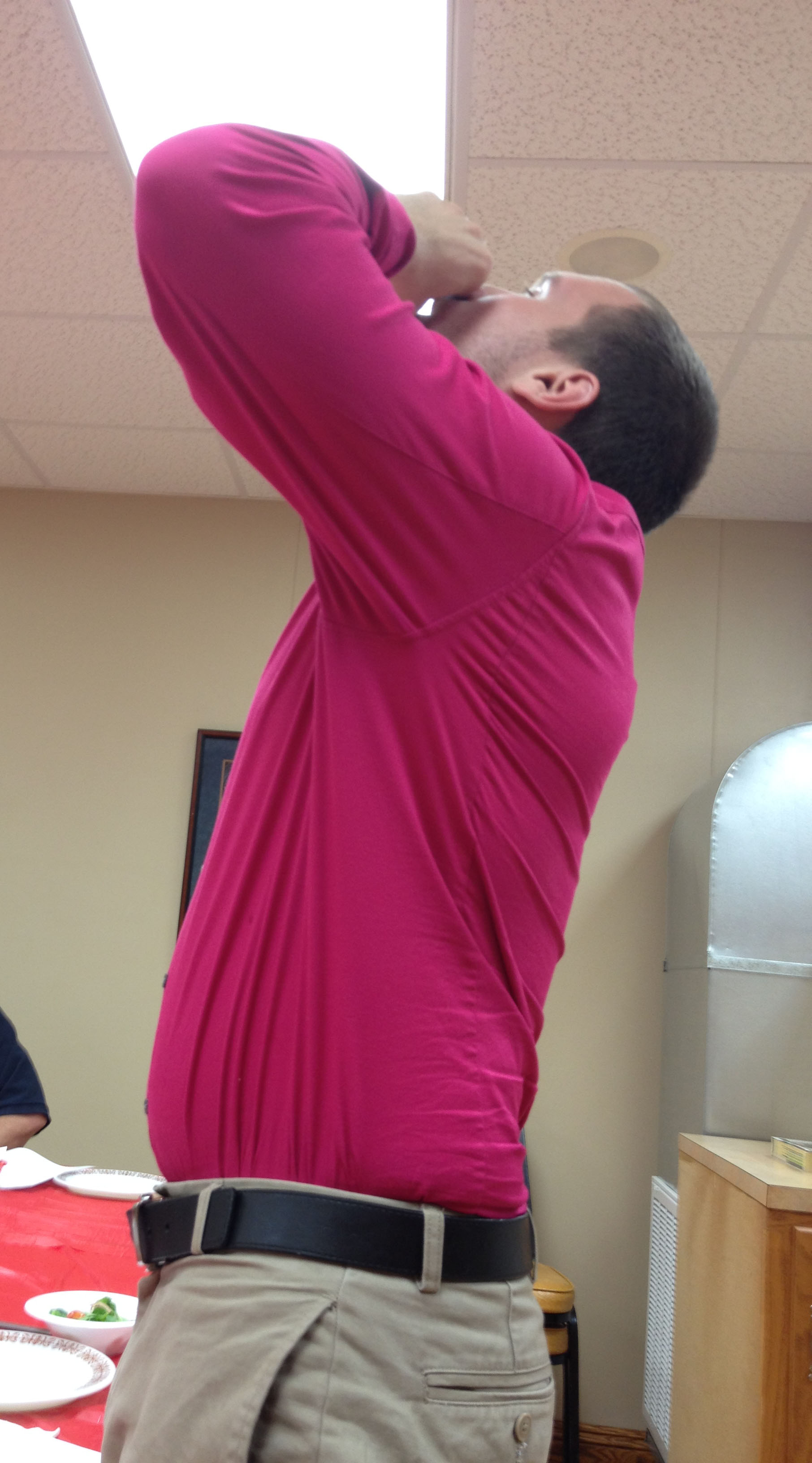
T demonstrating the meaning of the word

T demonstrating the meaning of the word “Fire.”

How does the whole thing work, though?

The table lodge is opened similarly as regular lodge might, albeit a much abridged version, with only a few speaking parts, all suitable for the public of course. Usually the opening ceremonies include a short history of the table lodge, or of  Ladies at the Table itself, as well as a history of the lodge that it is taking place in.The Chaplin gives a prayer to open. All of the work is conducted by the Worshipful Master, of course, who sits in the middle table of the “U” with his lady. After opening the Ladies at the Table, dinner is served. When everyone has had their fill, the real fun begins.

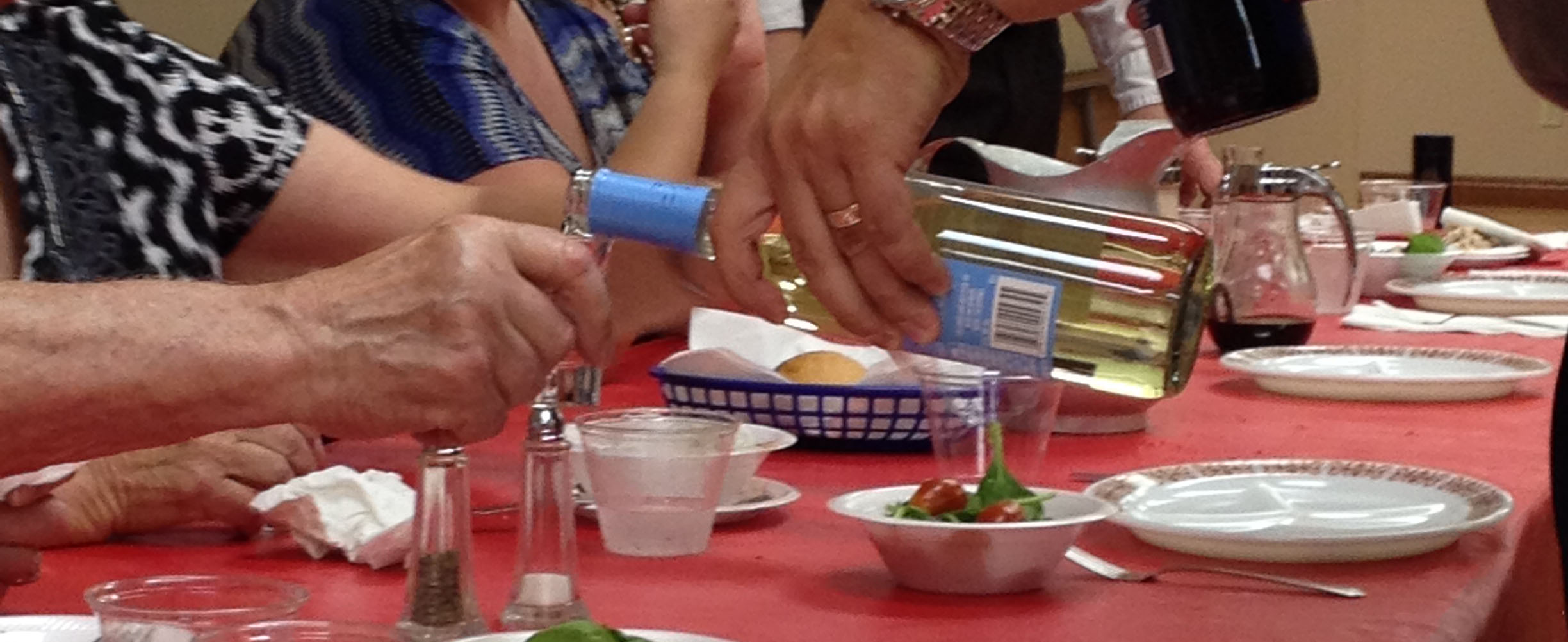
In addition to their water cups, everyone has a large shot glass at their seat. This is a special type of shot glass that is a bit thicker on the bottom, and with good reason. It is referred to as a “cannon”, and looks like this. After dinner is over, but before the toasts begin, someone, either the Worshipful Master or the Steward, instructs those attending how the toasts will be done. It goes something like this:

WM: “Brother Senior Steward, charge and align the Cannons of the column of the North. Brother Junior Steward, charge and align the Cannons of the column of the South.” The Stewards fill everyone’s cannons with wine.

WM: “Brothers Senior and Junior Steward, are you cannons charged?” They answer affirmatively.

The WM recognizes the person giving the toast, all rise, and the toast is given.

WM: “With me…” Everyone repeats the last line of the toast, for instance, “to the United States of America,” raising their cannons normally.

WM: “Ready.” Everyone  brings their cannons closer to their body.

WM: “Aim.” Cannon is brought to the lips.

WM: “Fire!” The shot of wine is downed.

WM:”Order.” The cannon is brought to just above the table.

WM: “Arms.” Everyone slams their cannon down on the table, hopefully at the same time, resulting in a terrific noise. (Usually it tends to get better with time, and then worse again.)

Traditionally, there are seven toasts made, as I stated above. At a Ladies at the Table, they are as follows:

  • To the first lady of the United States
  • To the wife of the Grand Master
  • To 3 different women of the Lodge
  • To our mothers
  • To our ladies

We chose to do things a bit differently, and added many of our own toasts, including:

  • To our service men and women
  • To the United States of America
  • To our Grand Lodge
  • To the Craft
  • T also added a special poem he had found about the ladies for the final toast. You can see that here.
The cannons being charged.

The cannons being charged.

So, the point is….?

If you are thinking to yourself that there must be something more to this than having a nice dinner, shooting wine, and being with the ladies of the lodge, then you would be pondering what else there is for some time. The whole point is to relax, have a nice time, and be with friends and family.

If any of you are interested in hosting your own Ladies at the Table, let me know! I would love to hear stories of the way that other Lodges decide to put it on. Make it your own, and start your own tradition!

A Look at the Lodge Room and its Officers

I had wanted to give a bit of a history lesson as to why women can’t become Freemasons this week, but due to a hiccup in research, I was forced to go another route. Hopefully I can get that done for you guys soon.

In the meantime, I realized yesterday that I had never actually gone over not only all of the officer positions that a Mason may hold while in Blue Lodge, but hadn’t even discussed how a lodge room is set up! I can assure you that while this information may feel like I am giving away deep, dark Masonic secrets, I can assure you that this is not the case. Please also be sure to note that this information is only accurate for blue lodges within the United States. In the later degrees and organizations, there are different officer positions, and the lodge room is set up slightly differently. I do not think that there is much if any difference for Masonry in the UK, but I do not know that for sure.

The Lodge Room

A.k.a, the place where all the super secret rituals take place. You can go in there. No, really. If you ever visit a Masonic lodge, and would like to see the lodge room, chances are that if you ask, and they are not currently holding a meeting, you are welcome to go in. To be honest, it’s not anything too special to see, but every piece of furniture in the room has a special purpose. Every lodge room is different, some are very elaborate, some are very simple, but they all contain a few key elements.

  • All lodge rooms are orientated east to west. Or this at least the attempt. The front of the lodge room, where the Worshipful Master (more on him later) sits is east. Even if it is not actually in the east, it is still referred to as such.
  • It is a rectangular room with seats around the perimeter. The idea here is pretty simple, you want everyone to have a good view of what is going on. There’s usually no more than two or three rows of seats, so you (hopefully) don’t get stuck sitting behind someone with giant hair like you might at the movies.
  • An altar in the middle of the room with a sacred text on it. In many parts of the country, this may be the Bible. In others, the Koran or the Torah. Some lodges have all three. It is referred to, not as the Bible, but as the Volume of Sacred Law.
  • Three candles in a triangle position around the altar. Threes are important to Masons (three degrees, three lead officers, etc), and the triangle acts as a reminder of the compass. These are usually electric candles, though not always. These are used when the Volume of Sacred Text is read aloud.
  •  Special chairs in the room for officers. More on this later.
  • Two pillars with globes on top. One of these is a globe of the Earth, and the other of the heavens. The pillars are fashioned after the two bronze columns from Solomon’s Temple, which is the location that all of the degrees revolve around. These are usually near the Senior Warden, or near the main entrance.
  • An illuminated letter G. This may hang over the Worshipful Master’s chair, or over the altar. The G stands for both G-d and for geometry, because it was the secret knowledge of the operant (building) masons.
  • Other structures vary by lodge. The floor around the altar may be a black and white checkerboard, because Solomon’s Temple was described as having a similar floor. It may have giant stones, one rough, and one nice and polished, these are referred to as the rough and perfect ashlar, respectively, and are used in an analogy during degree work. You may also find the lodge’s original charter in the room, as well as other masonic and masonic affiliated pieces in the room. Often the blue lodge is not the only group that meets in this room, and so you may find artifacts of York Rite, Order of the Eastern Star, or others as well.

Typical Lodge Officers

Remember when I said earlier that every officer has their own seat? That’s because there are thirteen officers within the lodge, each with their own job. Not sitting in the same spot every time would disrupt a ritual a great deal! There are two ways to get an officer position to get in at the bottom and sit in (almost) every chair, one each year, for a total of 7 years, or simply be appointed or elected to the position. Every officer position has a jewel of their office.

Layout of typical officers seats

  • Worshipful Master – Starting at the top and working our way down, we begin with the Worshipful Master. This is the head honcho, the guy in charge. This office is the highest honor to which a lodge can appoint any of its members. He sits in the big chair in the East, and oversees all business of his lodge. He also presides over all ritual and ceremony.  Think of him as the president of the lodge. Someone who used to be the Worshipful Master but is no longer is referred to as a Past Master. Note: The use of the word “worshipful” here is a honorific meaning “worthy of respect”, not one to be worshipped. His jewel is the square.
  • Senior Warden– Next “in line” is the Senior Warden. He is the second of the three principal officers in the lodge, think of him as the first vice president. The Senior Warden may act as Master of the lodge if he is unavailable,. Usually he will become Worshipful Master next year. His jewel of office is the level.
  • Junior Warden This is where it can start to get confusing. Think of the Junior Warden as the second Vice President of the lodge. He is the third of the three principal officers in the lodge, and may also be able to act as Master of the lodge if he is unavailable. In some lodges, the Junior Warden is in charge of making sure that visitors have the necessary credentials. He is also usually in charge of arranging meals.The jewel of this lodge is the plumb.
  • Senior Deacon The role of the Senior Deacon is to act as the Worshipful Master’s messenger. He will often carry orders between the Worshipful Master and the Senior Warden.  He also assures that the Volume of Sacred Text is opened to the correct page at the beginning and end of the meeting, and also lights and extinguishes the candles around the altar. The jewel of this office is the square and compass with the sun in the middle. He carries a rod with the jewel.
  • Junior Deacon The Junior Deacon acts as the Senior Deacon’s assistant, making sure that correspondence between the Worshipful Master and the other officers are carried out. He is also in charge of making sure that the Tyler is guarding the door at all times, and assuring that visitors have been vouched for. Some jurisdictions split this into two positions the Junior Deacon and the Inner Guard. The jewel of this office is a square and compass with a moon in it, and he carries a rod with the same symbol.
  • Senior and Junior Steward The Stewards are the assistant officers. They are the first to be asked to fill in if an officer could not make it to lodge. They also have the role of escorting the candidates around the lodge room during the degrees. The Junior Steward acts as an assistant to the Senior Steward when necessary. Stewards may sit in a different location than seen above, as their location is never mentioned in the ritual. The jewel of this lodge is the cornucopia. They both carry rods with this jewel. 
  • Treasurer Up until this point, all of these officer positions are in the progressive line. That is, if you start as a Junior Steward, if your lodge uses the progressive line system, in seven years you will be Worshipful Master, if you sit in every seat. The Treasurer is not in this line, and his job is exactly what you would think. He is responsible for all financial transactions within the lodge, including dues. Usually the same person will hold this position for many years. His jewel is the crossed keys.
  • Secretary Again, you can probably guess what this officer does. The secretary is in charge of all correspondence to members, minutes of Lodge meetings, petitions of new candidates, holds a continuous roster of lodge members, as well as other administrative duties. He communicates with the Grand Lodge, types letters, and receives the mail. He must be very well versed in his Grand Lodge’s By-Laws, as well as his Lodge’s By-Laws. For this reason the same person holds this office for many years. His jewel is the crossed quill pens.
  • Marshall The Marshall is the Lodge’s conductor of ceremonies. His job is chiefly the organization of processions, and ensuring that there the correct etiquette is carried out within the Lodge meetings. It is also his job to formally introduce visitors to the Lodge. His jewel is the crossed batons.
  • Chaplain The Chaplain is the spiritual leader of the lodge. Although he may not be a Minister, Rabbi, or Imam, he acts as such within the Lodge. He is responsible for prayers in the opening and closing of the meetings, as well as during degrees and before meals. Everything the Chaplain does is strictly nondenominational. His jewel is the opened book. 
  • Tyler (or Tiler)- Perhaps one of the most important officer positions within the Lodge is the Tyler. It is his duty to ensure that only those who are qualified enter the Lodge room, and that there are no eavesdroppers or unneccessary interruptions. It is also his job to ensure that all who enter the Lodge room are wearing a Masonic apron. His symbol is the sword, and he also carries (a not very sharp) one. 
  • Other officers There are many other officer positions, although these tend to vary from Lodge to Lodge, as well as from Grand Lodge to Grand Lodge. These include: Inner Guard, Chaplain, Director of Ceremonies/Ritualist, Marshal, Senior and Junior Master of Ceremony, Almoner, Organist/Director of Music, Superintendent of Works, Immediate Past Master, Orator, Historian, Charity Steward, Poet Laureate, and Pursuivant.

Whew! I know that is a lot of information, so be sure and re-read it a few times if you feel like you didn’t absorb any of the information. There are also officer positions that only exist at the Grand Lodge level, but I will not be covering those at this time.

I hope everyone has a great week, and if anyone is in eastern Nebraska, and is interested in attending a Ladies at the Table on Saturday, send me a message!

What a Relief!

I would like to start things a bit differently this week with a story:

A young man passed a pawnbroker’s shop. The money lender was standing in front of his shop, and the young man noted that he was wearing a large and beautiful Masonic emblem. After going on a whole block, apparently lost in thought, the young man turned back, stepped up to the pawnbroker, and addressed him: “I see you’re wearing a Masonic emblem. I’m a Freemason too. It happens that I’m desperately in need of $50 just now. I shall be able to repay it within ten days. You don’t know me; but I wonder whether the fact that you are a Freemason and that I am a Freemason is sufficient to induce you to lend me the money on my personal note.”

The pawnbroker mentally appraised the young man, who was clean-cut, neat and well-dressed. After a moments thought, he agreed to make the loan on the strength of the young man being a Freemason.  Within a few days the young man repaid the loan as agreed and that ended the transaction.

About four months later the young man was in a Lodge receiving the Entered Apprentice Degree; he had not really been a Mason when he borrowed the $50. After he had been admitted for the second section of the degree, the young man looked across the Lodge room and saw the pawnbroker from whom he had borrowed the $50. His face turned crimson and he became nervous and jittery. He wondered whether he had been recognized by the pawnbroker. Apparently not, so he planned at the first opportunity to leave the Lodge room and avoid his benefactor. As soon as the Lodge was closed he moved quickly for the door, but the pawnbroker had recognized the young man, headed him off and, to the young man’s astonishment, approached him and greeted him with a smile and outstretched hand.

“Well, I see you weren’t a Freemason after all when you borrowed that $50,” the pawnbroker commented.

The blood rushed to the young man’s face as he stammered, “No, I wasn’t, but I wish you’d let me explain. I had always heard that Freemasons were charitable and ready to aid a Brother in distress. When I passed your shop that day I didn’t need that $50. I had plenty of money in my wallet, but when I saw the Masonic emblem you were wearing, I decided to find out whether the things I’d heard about Freemasonry were true. You let me have the money on the strength of my being a Freemason, so I concluded that what I had heard about Masons was true, that they are charitable, that they do aid Brethren in distress. That made such a deep impression on me that I presented my petition to this Lodge and here I am. I trust that with this explanation you will forgive me for having lied to you.”

The pawnbroker responded, “Don’t let that worry you too much. I wasn’t a Freemason when I let you have the money. I had no business wearing the Masonic emblem you saw. Another man had just borrowed some money on it, and it was so pretty that I put it on my lapel for a few minutes. I took it off the moment you left. I didn’t want anyone else borrowing money on the strength of my being a Freemason. When you asked for that $50, I remembered what I had heard about Masons, that they were honest, upright, and cared for their obligations promptly. It seemed to me that $50 wouldn’t be too much to lose to learn if what I’d heard was really true, so I lent you the money and you repaid it exactly as you said you would. That convinced me that what I’d heard about Masons was true so I presented my petition to this Lodge. I was the candidate just ahead of you.”

From the January 1977 New Mexico Freemason

There are three main guidelines that Freemasons are taught, three main ideas to strive to achieve. These are Brotherly Love, Relief, and Truth. The two others I will be discussing in a later post; the one I would like to focus on here is relief, or charity. Masons are perhaps best known for their charity work, it is one of the few things that tends to put them in the public view. First and foremost, relief refers to helping out fellow brothers. This is discussed at more length here. This does not necessarily mean that there needs to be an emergency in order for relief to be given, just that a brother is in a tight spot, and could use some assistance. The point is, if you need help, do not hesitate to ask a brother.

The more known about type of charity when it comes to Masonry is public charity. Freemasons have a number of their own charities that assist the public, in addition to contributing to pre-established ones.

Shriner’s Hospital

Perhaps the most well-known Masonic charity is the Shriners Hospital for Children, owned by, you guessed it, the Masonsic appendant body Shriners International. They have numerous locations all over the United States, however they only specialize in four areas: burns, cleft palate, orthopedic and spinal cord injuries. This sets it apart from the children’s hospital that you may have in your city that will see children with a large variety of issues. Focusing on only four areas allows them to have more specialists and more specialized equipment, therefore being able to provide a higher level of care for the children that see them. A major aspect of Shriner’s Hospital is that they will not turn down a family because of their inability to pay. As a member of the Shrine, you pay a $5 “hospital assessment” fee with your dues, which goes directly to the hospital. In addition to this, many Shrines will hold fundraisers for the hospital, as well as individual hospitals themselves holding fundraisers. The Shriner’s Hospital is the beneficiary of many wills as well, of both Masons and non-Masons.

Masonic-Eastern Star Homes

A quick Google search of “Masonic-Eastern Star home” will give you results for two vastly different age ranges. Both the Masonic-Eastern Star Home for Children, and the Masonic-Eastern Star Retirement homes are services provided by Blue Lodges and Star chapters. However, only one of these are a charity the children’s home. The concept is similar to that of the Shriner’s Hospital, no one is turned away due to their inability to pay. The children’s homes offer safe havens for children who may not otherwise be able to live at home: runaways, cases of abuse or neglect, or simply children of divorce. The homes provide them with a stable environment to grow in, and almost all of the children’s homes have on campus schooling. There is no requirement that the child be that of a mason, or related to one in any way. The homes are funded by Masons giving donations, non-Masons giving donations, and of course fundraisers. Many children that attended the homes go on to join the Craft. These homes are generally run by a board of MM or Star members. There is not one overarching organization for these homes, instead they are usually run by the jurisdiction they reside in.

Rite Care

A little bit different, the Rite Care clinics are the charities of the Scottish Rite. Rite Care provides speech and language therapy for children (as you might have guessed!). The idea is that while schools often provide speech and language therapies at school, a school therapist may be seeing several children in one day, and often there is simply not enough time for some kids to get the help that they need. Alternatively, some children may require more intense therapy than may be able to be provided in the school setting. Usually Rite Care clinics are associated with a local hospital, in the big O the clinic works alongside the university hospital. There are currently over 175 clinics in the United States, giving tens of thousands of children the ability to communicate with the world. Most of the funding comes from the Scottish Rite Foundation, as well as from local Scottish Rite lodges, and of course, non-Masonic donations. Again, no child is turned away because of an inability to pay.

There are numerous other Masonic affiliated charities. To give you an idea…

  • Blue Lodge: CHiP program
  • Job’s Daughters: HIKE (Hearing Impaired Kid’s Endowment Fund)
  • Knights Templar: Knights Templar Eye Foundation
  • Royal Arch: Royal Arch Research assistance Program (Supports research into auditory perception disorders in children)
  • Grottos of North America: Humanitarian Foundation Dentistry for the Handicapped
  • Cryptic Masons: Cryptic Masons Medical Research Foundation (Supports arteriosclerosis research)
  • And a LOT more!

This is only in the United States of course. Over in the UK the Masonic charities are very well-organized, and are all overseen by the Grand Charity. They also have the Royal Trust for Boys and Girls, the Royal Masonic Benevolent Institution, and the Masonic Samaritan Fund.

So, we know that Masons give charity, and who they give to, but why is it that they give to charity? Surely there is something beyond “this book said it was a good idea”. I think it is best summed up in this song:

An Introduction to Scotch

At least around here, there tends to be one popular drink among Masons- single malt scotch. In fact, not only does our local Scottish Rite put on a scotch tasting every so often (with one next week!), but during major events like Grand Lodge, everyone brings out their bottles, and it becomes almost a traveling scotch club, with everyone trying new varieties and enjoying the fellowship that goes along with sharing a similar hobby. I will be the first to admit that I was not a fan of the stuff the first few times I tried it, but now it’s almost my exclusive drink, and with good reason.

What exactly is scotch?

Scotch, or scotch whisky, or single malt scotch,is very simply, a whisky made in Scotland in a very specific manner (actually, by specific laws!) It is almost easier to say what single malt scotch is not. It is not made in America, like Maker’s Mark, or Jack Daniels, nor is it made in Canada, like Crown Royal, it isn’t even made in Ireland, like Jameson. Perhaps the easiest way to tell where it is made is by the bottle- if it says whisky, it is made in Scotland, anywhere else is whiskey, usually even marked “Irish whiskey”, for Jameson, for example.

In addition to this, there are five categories of scotch whisky itself:

  • Single malt- a scotch made by one distillery, made only with malted barley mash, the topic of this post
  • Single grain- a scotch made by one distillery, made with a grain other than barley, like corn or rye
  • Blended scotch – a blend of one or more single malt and one or more single grain
  • Blended malt- a blend of single malts, that were all made at different distilleries
  • Blended grain- a blend of single grains, that were all made at different distilleries.

It can be a little confusing and overwhelming at first, but for the purpose of this post, we will only be discussing single malt scotch whisky, which means it was made with 100% malted barley mash, by a single distillery, in Scotland.

There’s different types of scotch?

So, when I first started drinking scotch, I was thinking about it more like vodka. Yes, some vodkas are a better quality than others, and therefore taste a bit better, but they are essentially all the same vodka.  This is not true at all with scotch. Think about scotch more like wine.  Not only do you have the option between red and white, but also merlot, cabernet, chardonnay, riesling and many more. Scotch is much more like wine, because where the distillery is located in the country, tends to dictate its flavor. So, just like you know that you may love syrahs and hate pinot noirs, the same tends to be true about scotch. If you enjoy a scotch from one location, you will probably enjoy another from a different distillery. The nice thing about scotch is that there are only 6 (traditionally 5) regions that scotches come from, instead of the numerous types of wine.

Starting at the bottom and working our way up, the regions of scotch are:

  • Lowland– These are considered the most light bodied scotches, because they are (usually) triple distilled. There are only 4 distilleries open in the lowlands currently, Ailsa Bay, Glenkinchie, Auchentoshan, and Bladnoch.
  • Cambelton- The scotch from this region is peaty (scotch talk for smokey), and tends to have a hint of salt. Cambelton was once the scotch capital, with over 30 distilleries. Now, only three remain: Glen Scotia, Glengyle, and Springbank
  • Islay- Pronounced “eye-luh”, scotches from this region tend to be the strongest and the smokiest. This is usually accredited to the high winds and seas. Distilleries in this region include  Laphroaig, Lagavulin, Bowmore, and  Ardbeg.
  • Highland- The region loved in my house the most, Highland scotches tend to have underlying tastes of peat and smoke, and are usually considered to be very full-bodied. The region is further divided, into Northern ( full and rich), Southern (light, dry and fruity), Eastern (full, dry and very fruity), and Western (full, with lots of peat and smoke). Some distilleries in this region include Oban, Glenmorangie and Dalmore
  • Speyside- Now considered the center for whisky, Speyside scotches have some of the most complex flavors, usually very sweet. The distilleries will often use water right from the river Spey, that cuts through the region. Some distilleries include Glenfiddich, The Glenlivet, and The Macallan
  • Island-Although technically considered part of the Highland region, distilleries in the Island are starting to make a name for themselves. There is no hard and fast rule, although they do tend to be fairly mild, usually somewhere in between a Highland and an Islay, with a focus on the peaty flavor. Distilleries in this region include Highland Park and Talisker

This stuff tastes like gasoline, is there a better way to drink it?

If you are lucky, you have a community of scotch drinkers in your area, probably at your lodge or shrine. If not, you may want to try going to  bar and ordering a scotch, chances are they will only have one or two for you to choose from, unless it is a specialty bar. Usually, scotch is ordered in drams, with one dram equaling to about 2 ounces. Unless you have been a rye drinker for years, I can almost guarantee that you will not care for scotch the first (few) times you give it a try. The first time I did, I thought it smelled and tasted like kerosene, and as the smell burned my nose hairs, I wondered who in their right mind would be willing to drink this stuff. I’ve been drinking scotch for about a year now, and even still, there are times when I am not in the mood to drink it down. However, much like wine, there is a preferred method of drinking a scotch.

  • I cannot say this enough, SCOTCH IS A SIPPING DRINK. Not only because it allows you to appreciated the flavor more, but because bottles of the stuff can easily break the $100 mark. It’s not something you take shots of and not something you make mixed drinks with (that’s what  whiskey tends to be for).
  • There is a special kind of glass for scotch, you can get them here, although there is nothing wrong with drinking it out of a tumbler, preferably glass.
  • While adding ice is generally considered poor form, chilled or not is really up to you. They do make special rocks called whisky stones that keep your drink cold without adding water, you can get those here.
  • Some people do add water to their scotch, since it will help cut the burn, and allows you to taste flavors that may of been masked by it. Add slowly, however, and taste your scotch before adding more.
  • As far as actually drinking it is concerned, first, you will want to nose, or smell it. Don’t stick your nose in the glass, you shouldn’t feel any burn in your nose. A swirl or two will help release more of the scent. Then, take a tiny sip, just enough to cover your tongue. In order to get the real flavor, you will want to hold it in your mouth for a bit, about 10 seconds or so. You might think that your tongue is shriveling up and dying, but after a few seconds, the burn will dissipate, and you will actually get the flavor of the scotch. Moving your tongue around, you will be able to detect different flavors. After you swallow, you will be able to detect the finish on your tongue and gums. Remember- even the most expensive scotch will burn your tongue if you just sip and swallow it, without actually tasting it.

Okay, I’m willing to try it, but how do I decide which one?

Buying scotch is again, a bit like buying wine. Scotches have different years, and distilleries will usually produce specific years, with the occasional unusual year that tends to be a special edition. The years refer to the number of years they spent in the barrel. Unlike wine, however, scotch does not age in the bottle, so a 12 year scotch will always be a 12 year scotch in the bottle, opened or not. Scotches are usually referred to by their year, followed by their distillery, for example, the 14 year Oban is a favorite at our house. Usually the younger the scotch, the cheaper the price, but they tend to carry the  harsher  burn, and the more subtle the flavors.

There tends to be two scotches that are recommended most often for the beginner scotch drinker:

The 10 year old Glenmorangie, from the Highland region. This was my first scotch as well. It tends to be fairly inexpensive as far as scotch goes, at around $35 a bottle. That may sound like a lot, but remember that one bottle will last you for weeks, perhaps longer, depending on how often you drink.The flavor is fairly fruity, mostly citrus and peach, with hints of vanilla and honeysuckle. It is beautiful in it’s complexity within it’s simplicity.

The second most recommended scotch for a beginner is the 12 year Glenlivet. It is a Speyside scotch, and while it does not have the complex flavor of the Glenmorangie,  it does have a very easy to drink taste of oak and vanilla. It is actually the most popular single malt sold in the United States. The price is comparable to the Glenmorangie, at around $30 a bottle.

Remember that the first bottle that you buy is not as important as trying new scotches and improving and expanding your palate. Each bottle will give you a better idea of flavors that you enjoy, as well as those that you do not care for.

What does all of this have to do with Masonry?

On the surface, not much. Remember, however, that a major component of Masonry is brotherhood. Similar hobbies, intrests, likes and dislikes help foster and nurture the brotherhood within a lodge or even jurisdiction. If your lodge or area has a scotch club, go to a meeting and check it out. If you do not, start one with like minded brothers. Many activities can be brought about from scotch drinking, from just trying drinks from each others collections, hosting scotch tastings, or even visiting Scotland to go on a tour of your favorite distilleries. It will help bring you and your brothers closer, which makes for a stronger lodge. Don’t forget to invite the ladies! Just because scotch is often labeled as “the gentleman’s drink” doesn’t mean women don’t like it as well. While a scotch tasting does not make for a great family activity, it does make for a nice evening out with your lady.

All in the Family

For those of you who don’t know me personally, I work at a children’s hospital in my city, caring for babes and teenagers alike. While I was at work this past weekend, my mind wandered to Freemasonry, and how it relates to and affects our families.  After a few quick Google searches, I was a bit flabbergasted to learn that there was actually little to no factual, informative material on how the two interact, and indeed, support one another.

Generation to generation

Perhaps the most common, and often the most asked about topic when it comes to Masonry and family is that of Masonic lineage. Since Masonry was very popular in the 1920’s and 30’s, many of your grandparents or great (or perhaps even great-great), grandparents were involved. You may be surprised to discover this about your family, but with a little bit of digging, asking family, and making some phone calls, it is fairly easy to ascertain a distant relative’s lodge.  This does take a bit more legwork than just doing a Google search, because most lodges do not keep records of past members on their websites, and even if they do, it is usually only the names of past Worshipful Masters. If you are having a hard time tracking down a relative’s credentials, I would recommend contacting the Grand Lodge that you believe they were a member of most recently.

Something that happens not as often as I think it should is one family member raising another into the lodge. This is most often seen as father to son, but I have heard numerous stories of uncle to nephew, cousin to cousin, (blood) brother to brother, and even occasionally, a son raising his father.  T was lucky enough to be raised by his wonderful stepfather, who also installed him as Worshipful Master this year; and¸will be raising T’s oldest brother near the end of this year.

Sometimes, however, I think that sometimes there is a break between generations, usually for one of two reasons, but of course not limited to these two. The first case is that the father is not sure how to approach the subject with his son. For whatever reason, the Mason may feel uncomfortable discussing it, or may not be sure how to approach the topic. Related to this, the father may feel that his son needs to ask, since Masonry heavily enforces the “to be one, ask one” concept. The other way that it usually skips a generation, is that the son may not be interested, or may reject his father’s invitation. This was the case with my own family, as my father was invited to join lodge by my grandfather, but my father was not interested in Masonry at the time. I was more than happy to pick up the torch and continue the tradition of being a Masonic family.

The Masonic Family

Usually when someone is discussing the idea of the Masonic family, they are talking about all of the groups related to Masonry, Blue Lodge, Job’s Daughters, Scottish Rite, etc.  And, it is true, Masonry is a type of family within its own right, both within a specific organization, as well as between. There is, however, another type of Masonic family, perhaps the one that the outsider may think of first- the family raised in and brought together through Masonry. Freemasonry actually lends itself to this idea quite easily.

When you think about it, the idea really makes sense, and the organization of Masonry is that every family member can be a part of it. As you know, there are numerous organizations for women and youth. In addition to this, however, all lodges and jurisdictions put on some sort of family event at least once a year, but usually much more often than that. These usually include picnics, trips to the zoo and circus, or even just a BBQ at the lodge building. The nice thing is that it does not usually take much to organize a family event, and it allows you to meet other families that you already have something in common with-Masonry. If, for some reason, events do not happen like this at your lodge, suggest them to the Worshipful Master or events committee, or even volunteer to put it together yourself.

One of the things that Masonry offers that I feel are not mentioned as much as it should be, is support. Yes, usually support for the Mason is mentioned, however the amount of support that is available to the family as a whole is usually not mentioned to anyone other than the Mason himself.  One of the focuses of Freemasonry is charity, and this extends to its members as well. The two main ways of support that Masonry offers are financial- the Masonic Relief Fund is set up by every lodge and grand lodge, to serve as assistance in dire financial straits. The other form of financial support is through scholarships- for college, mostly, although my chapter does give one out for a Masonic youth band camp. In addition to the financial support, Masonry offers a wide array of emotional support as well; not only through fellowship, but also through actual support groups, such as Masonic widows and widowers. These vary from jurisdiction to jurisdiction of course, but many groups are moving online, making them more accessible.

Most often, when you look for something regarding Masonry and families, you will quickly come across two kinds of posts: you will find a lot of conspiracy theorists stating that Masonry is evil and set out to brainwash the men and kidnap the women, and, you will find a number of women that claim that Masonry is the reason for their divorce. Please remember, that above all else, Masonry teaches that family comes first. Masonry is not out to take your husband away from you, nor is it looking to ruin your marriage. Instead, enjoy the nights that your husband goes to lodge, do something nice for yourself, or something special with your children. If you feel that he is becoming too involved in lodge, or that it is becoming a priority over his family, communicate that with him. If he, for whatever reason, does not agree with you, or is not interested in talking with you about it, contact his Worshipful Master and express your concerns to him. In addition to this, if you have a question about lodge, Masonry, or anything related, or simply want to learn more, ask. The only things he cannot share with you are usually specific words or phrases used in the ritual, and secret symbols, such as handshakes.
The point of all of this is, quite simply, that Masonry is more than just something for the Mason, or the man of a household. Masonry can easily encompass the entire family’s needs and social calendar. More than that, Freemasonry allows for a family tradition to be started, or continued, and is something that is easily passed on from generation to generation. Nothing is cooler than receiving pins that belonged to a great-grandparent whom you never met, and know that you stand where they once did. It is a way of bringing the entire family together, not drive you apart, as some people would have you believe. Long story short, Freemasonry is a family affair.