Ladies at the Table

Ever have one of those days where everything falls perfectly into place, where nothing deviates from the plan, and everything works out just wonderfully? Saturday was not that day. T and I were set to host Ladies at the Table at the lodge, and numerous things went wrong, including my truck breaking down, the smoker not cooking the brisket not once, but twice, and I think I caught the stove on fire at one point. Luckily, T’s quick thinking resulted in us only being 30 minutes behind schedule, and we were able to have a wonderful dinner and table lodge with our friends and family.

Ladies where?

Ladies at the Table is a very different kind of Masonic event. It is not a degree, a ritual, or ceremony, but it does fall under the jurisdiction of your Grand Lodge, and is usually held at Grand Lodge Communications. The idea is that this is the time for a lodge to show their respect and honor toward a Mason’s lady, widow, mother, daughter, sweetheart, sister…I think you get the picture.  Since, more often than not, the Mason will leave his lady home while he eats at the lodge, this is an opportunity for her to come and feel not only welcomed, but supported and honored in her role as a Mason’s lady. It also gives the ladies of the lodge a chance to not only meet the men that her Mason has been hanging out with, but also the other ladies at the lodge, and perhaps spark her interest in joining the Masonic community.

I will get to how the whole business runs, and it really is quite fun, in a moment. First, I want to go over where the idea came from in the first place. During the 18th century, another type of Masonry was being practiced in France, called French Rite, which was established to parallel Masonry. These “Adoptive Lodges”, were women only, and were called such because a regular Masonic lodge “adopted” them. These lodges had four degrees, Apprentice (or Female Apprentice); Compagnone (or Craftswoman); Maitresse (or Mistress); and Parfaite Maconne (or Perfect Mason.) The fourth degree ended with a Table Lodge, or ceremonial banquet. There is a large possibility that young Englishmen, that were en route to be trained as British military officers attended the final degree, or at least the dinner that followed, and brought it back to regular Masonry .The table lodge is still practiced today in many regular jurisdictions, you may have attended one on Saint John’s Day, or around the winter holidays. Please note- Ladies at the Table is not Adoptive Masonry. It is simply a  borrowed ceremony that is used by a regular Lodge of Masons to show respect and honor to the Ladies of their Lodge.

The “U” shape. Not ours, I did not think that far ahead!

How is this different from a regular Lodge or Chapter meeting?

If you’ve never been to a table lodge, or Ladies at the Table before, you will find that it is quite unlike anything else you have experienced within Masonry before. As I said above, it is not a Masonic ritual, in fact, T and I decided to make ours a very casual, relaxed event. This does not mean, however, that it is not without it’s own set of governing rules. While these vary from jurisdiction to jurisdiction, as well as Lodge to Lodge, I will give you a general idea:

  • Traditionally there are 5 courses and 7 toasts to the meal. Our Lodge decided to be much more informal, and relaxed, and therefore had 3 courses, and probably 10 toasts. Some will say that this does not make it a true “table lodge”, but I think that a lot of things like this you need to adapt to fit your own needs and desires.
  • The tables are set in a U shape, with the altar, holding the Bible or other holy book, in the center. T had been in charge of choosing the ritual and letting me know what we needed, and after all of the stress of the day, we realized we had missed this part. Life goes on.
  • Wine is the only alcohol served. You may see a lot of rules about how much wine everyone should be poured, or even what alcohol percentage the wine should be. Unless your Grand Lodge has specific rules for this, do what suits your needs.
  • The ladies should not be the ones cooking, or serving this meal. The idea is to show how much you appreciate them by doing what they normally might on any other lodge night.
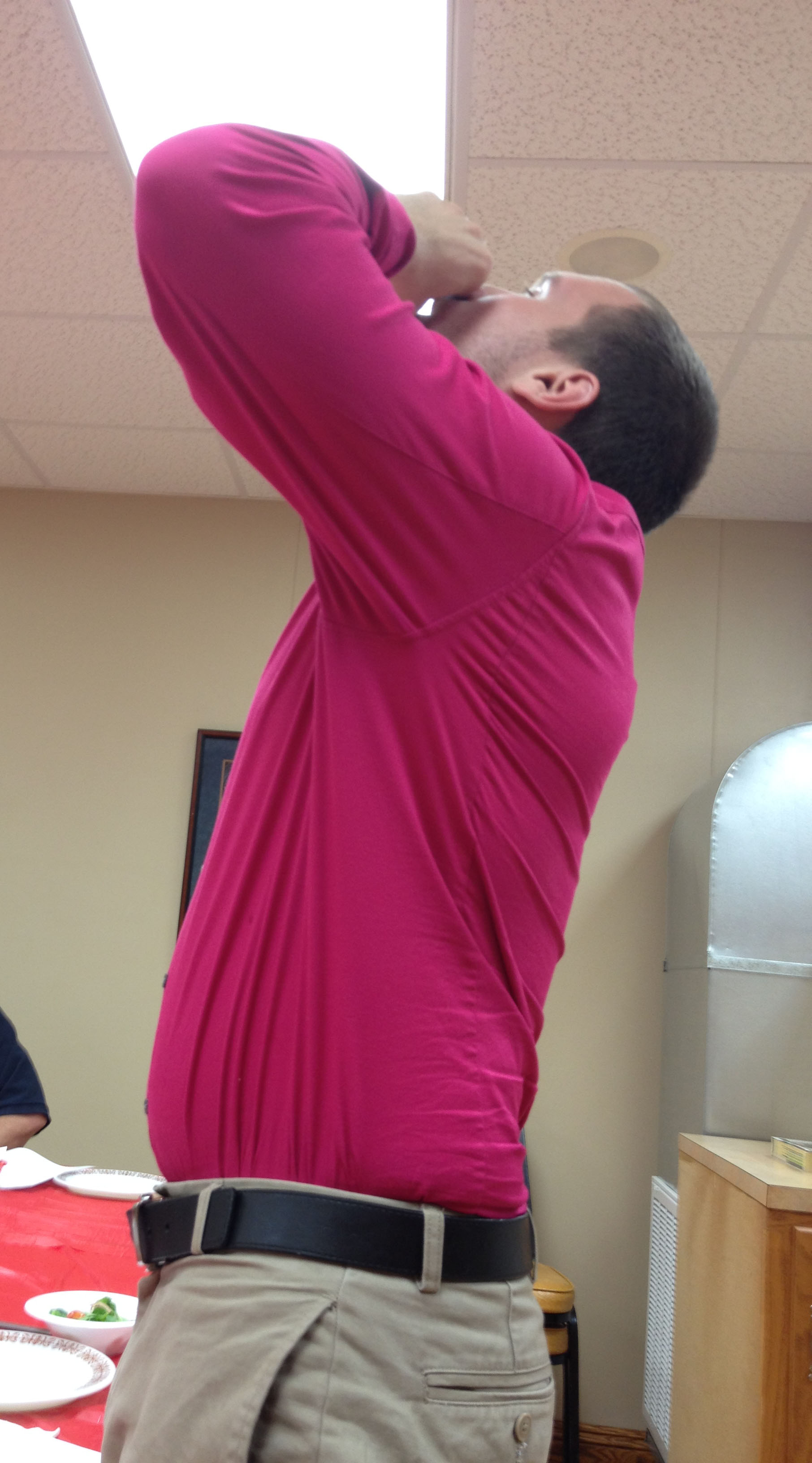
T demonstrating the meaning of the word

T demonstrating the meaning of the word “Fire.”

How does the whole thing work, though?

The table lodge is opened similarly as regular lodge might, albeit a much abridged version, with only a few speaking parts, all suitable for the public of course. Usually the opening ceremonies include a short history of the table lodge, or of  Ladies at the Table itself, as well as a history of the lodge that it is taking place in.The Chaplin gives a prayer to open. All of the work is conducted by the Worshipful Master, of course, who sits in the middle table of the “U” with his lady. After opening the Ladies at the Table, dinner is served. When everyone has had their fill, the real fun begins.

In addition to their water cups, everyone has a large shot glass at their seat. This is a special type of shot glass that is a bit thicker on the bottom, and with good reason. It is referred to as a “cannon”, and looks like this. After dinner is over, but before the toasts begin, someone, either the Worshipful Master or the Steward, instructs those attending how the toasts will be done. It goes something like this:

WM: “Brother Senior Steward, charge and align the Cannons of the column of the North. Brother Junior Steward, charge and align the Cannons of the column of the South.” The Stewards fill everyone’s cannons with wine.

WM: “Brothers Senior and Junior Steward, are you cannons charged?” They answer affirmatively.

The WM recognizes the person giving the toast, all rise, and the toast is given.

WM: “With me…” Everyone repeats the last line of the toast, for instance, “to the United States of America,” raising their cannons normally.

WM: “Ready.” Everyone  brings their cannons closer to their body.

WM: “Aim.” Cannon is brought to the lips.

WM: “Fire!” The shot of wine is downed.

WM:”Order.” The cannon is brought to just above the table.

WM: “Arms.” Everyone slams their cannon down on the table, hopefully at the same time, resulting in a terrific noise. (Usually it tends to get better with time, and then worse again.)

Traditionally, there are seven toasts made, as I stated above. At a Ladies at the Table, they are as follows:

  • To the first lady of the United States
  • To the wife of the Grand Master
  • To 3 different women of the Lodge
  • To our mothers
  • To our ladies

We chose to do things a bit differently, and added many of our own toasts, including:

  • To our service men and women
  • To the United States of America
  • To our Grand Lodge
  • To the Craft
  • T also added a special poem he had found about the ladies for the final toast. You can see that here.
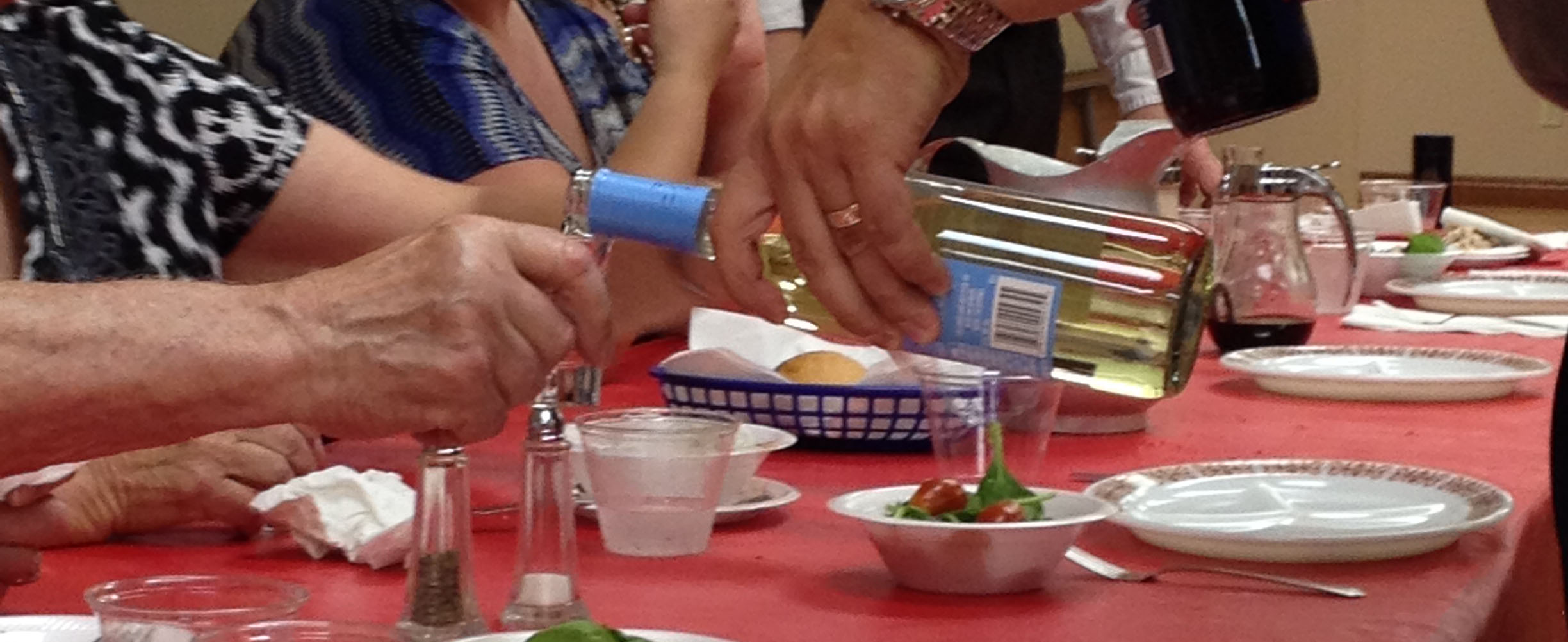
The cannons being charged.

The cannons being charged.

So, the point is….?

If you are thinking to yourself that there must be something more to this than having a nice dinner, shooting wine, and being with the ladies of the lodge, then you would be pondering what else there is for some time. The whole point is to relax, have a nice time, and be with friends and family.

If any of you are interested in hosting your own Ladies at the Table, let me know! I would love to hear stories of the way that other Lodges decide to put it on. Make it your own, and start your own tradition!

A Look at the Lodge Room and its Officers

I had wanted to give a bit of a history lesson as to why women can’t become Freemasons this week, but due to a hiccup in research, I was forced to go another route. Hopefully I can get that done for you guys soon.

In the meantime, I realized yesterday that I had never actually gone over not only all of the officer positions that a Mason may hold while in Blue Lodge, but hadn’t even discussed how a lodge room is set up! I can assure you that while this information may feel like I am giving away deep, dark Masonic secrets, I can assure you that this is not the case. Please also be sure to note that this information is only accurate for blue lodges within the United States. In the later degrees and organizations, there are different officer positions, and the lodge room is set up slightly differently. I do not think that there is much if any difference for Masonry in the UK, but I do not know that for sure.

The Lodge Room

A.k.a, the place where all the super secret rituals take place. You can go in there. No, really. If you ever visit a Masonic lodge, and would like to see the lodge room, chances are that if you ask, and they are not currently holding a meeting, you are welcome to go in. To be honest, it’s not anything too special to see, but every piece of furniture in the room has a special purpose. Every lodge room is different, some are very elaborate, some are very simple, but they all contain a few key elements.

  • All lodge rooms are orientated east to west. Or this at least the attempt. The front of the lodge room, where the Worshipful Master (more on him later) sits is east. Even if it is not actually in the east, it is still referred to as such.
  • It is a rectangular room with seats around the perimeter. The idea here is pretty simple, you want everyone to have a good view of what is going on. There’s usually no more than two or three rows of seats, so you (hopefully) don’t get stuck sitting behind someone with giant hair like you might at the movies.
  • An altar in the middle of the room with a sacred text on it. In many parts of the country, this may be the Bible. In others, the Koran or the Torah. Some lodges have all three. It is referred to, not as the Bible, but as the Volume of Sacred Law.
  • Three candles in a triangle position around the altar. Threes are important to Masons (three degrees, three lead officers, etc), and the triangle acts as a reminder of the compass. These are usually electric candles, though not always. These are used when the Volume of Sacred Text is read aloud.
  •  Special chairs in the room for officers. More on this later.
  • Two pillars with globes on top. One of these is a globe of the Earth, and the other of the heavens. The pillars are fashioned after the two bronze columns from Solomon’s Temple, which is the location that all of the degrees revolve around. These are usually near the Senior Warden, or near the main entrance.
  • An illuminated letter G. This may hang over the Worshipful Master’s chair, or over the altar. The G stands for both G-d and for geometry, because it was the secret knowledge of the operant (building) masons.
  • Other structures vary by lodge. The floor around the altar may be a black and white checkerboard, because Solomon’s Temple was described as having a similar floor. It may have giant stones, one rough, and one nice and polished, these are referred to as the rough and perfect ashlar, respectively, and are used in an analogy during degree work. You may also find the lodge’s original charter in the room, as well as other masonic and masonic affiliated pieces in the room. Often the blue lodge is not the only group that meets in this room, and so you may find artifacts of York Rite, Order of the Eastern Star, or others as well.

Typical Lodge Officers

Remember when I said earlier that every officer has their own seat? That’s because there are thirteen officers within the lodge, each with their own job. Not sitting in the same spot every time would disrupt a ritual a great deal! There are two ways to get an officer position to get in at the bottom and sit in (almost) every chair, one each year, for a total of 7 years, or simply be appointed or elected to the position. Every officer position has a jewel of their office.

Layout of typical officers seats

  • Worshipful Master – Starting at the top and working our way down, we begin with the Worshipful Master. This is the head honcho, the guy in charge. This office is the highest honor to which a lodge can appoint any of its members. He sits in the big chair in the East, and oversees all business of his lodge. He also presides over all ritual and ceremony.  Think of him as the president of the lodge. Someone who used to be the Worshipful Master but is no longer is referred to as a Past Master. Note: The use of the word “worshipful” here is a honorific meaning “worthy of respect”, not one to be worshipped. His jewel is the square.
  • Senior Warden– Next “in line” is the Senior Warden. He is the second of the three principal officers in the lodge, think of him as the first vice president. The Senior Warden may act as Master of the lodge if he is unavailable,. Usually he will become Worshipful Master next year. His jewel of office is the level.
  • Junior Warden This is where it can start to get confusing. Think of the Junior Warden as the second Vice President of the lodge. He is the third of the three principal officers in the lodge, and may also be able to act as Master of the lodge if he is unavailable. In some lodges, the Junior Warden is in charge of making sure that visitors have the necessary credentials. He is also usually in charge of arranging meals.The jewel of this lodge is the plumb.
  • Senior Deacon The role of the Senior Deacon is to act as the Worshipful Master’s messenger. He will often carry orders between the Worshipful Master and the Senior Warden.  He also assures that the Volume of Sacred Text is opened to the correct page at the beginning and end of the meeting, and also lights and extinguishes the candles around the altar. The jewel of this office is the square and compass with the sun in the middle. He carries a rod with the jewel.
  • Junior Deacon The Junior Deacon acts as the Senior Deacon’s assistant, making sure that correspondence between the Worshipful Master and the other officers are carried out. He is also in charge of making sure that the Tyler is guarding the door at all times, and assuring that visitors have been vouched for. Some jurisdictions split this into two positions the Junior Deacon and the Inner Guard. The jewel of this office is a square and compass with a moon in it, and he carries a rod with the same symbol.
  • Senior and Junior Steward The Stewards are the assistant officers. They are the first to be asked to fill in if an officer could not make it to lodge. They also have the role of escorting the candidates around the lodge room during the degrees. The Junior Steward acts as an assistant to the Senior Steward when necessary. Stewards may sit in a different location than seen above, as their location is never mentioned in the ritual. The jewel of this lodge is the cornucopia. They both carry rods with this jewel. 
  • Treasurer Up until this point, all of these officer positions are in the progressive line. That is, if you start as a Junior Steward, if your lodge uses the progressive line system, in seven years you will be Worshipful Master, if you sit in every seat. The Treasurer is not in this line, and his job is exactly what you would think. He is responsible for all financial transactions within the lodge, including dues. Usually the same person will hold this position for many years. His jewel is the crossed keys.
  • Secretary Again, you can probably guess what this officer does. The secretary is in charge of all correspondence to members, minutes of Lodge meetings, petitions of new candidates, holds a continuous roster of lodge members, as well as other administrative duties. He communicates with the Grand Lodge, types letters, and receives the mail. He must be very well versed in his Grand Lodge’s By-Laws, as well as his Lodge’s By-Laws. For this reason the same person holds this office for many years. His jewel is the crossed quill pens.
  • Marshall The Marshall is the Lodge’s conductor of ceremonies. His job is chiefly the organization of processions, and ensuring that there the correct etiquette is carried out within the Lodge meetings. It is also his job to formally introduce visitors to the Lodge. His jewel is the crossed batons.
  • Chaplain The Chaplain is the spiritual leader of the lodge. Although he may not be a Minister, Rabbi, or Imam, he acts as such within the Lodge. He is responsible for prayers in the opening and closing of the meetings, as well as during degrees and before meals. Everything the Chaplain does is strictly nondenominational. His jewel is the opened book. 
  • Tyler (or Tiler)- Perhaps one of the most important officer positions within the Lodge is the Tyler. It is his duty to ensure that only those who are qualified enter the Lodge room, and that there are no eavesdroppers or unneccessary interruptions. It is also his job to ensure that all who enter the Lodge room are wearing a Masonic apron. His symbol is the sword, and he also carries (a not very sharp) one. 
  • Other officers There are many other officer positions, although these tend to vary from Lodge to Lodge, as well as from Grand Lodge to Grand Lodge. These include: Inner Guard, Chaplain, Director of Ceremonies/Ritualist, Marshal, Senior and Junior Master of Ceremony, Almoner, Organist/Director of Music, Superintendent of Works, Immediate Past Master, Orator, Historian, Charity Steward, Poet Laureate, and Pursuivant.

Whew! I know that is a lot of information, so be sure and re-read it a few times if you feel like you didn’t absorb any of the information. There are also officer positions that only exist at the Grand Lodge level, but I will not be covering those at this time.

I hope everyone has a great week, and if anyone is in eastern Nebraska, and is interested in attending a Ladies at the Table on Saturday, send me a message!

What a Relief!

I would like to start things a bit differently this week with a story:

A young man passed a pawnbroker’s shop. The money lender was standing in front of his shop, and the young man noted that he was wearing a large and beautiful Masonic emblem. After going on a whole block, apparently lost in thought, the young man turned back, stepped up to the pawnbroker, and addressed him: “I see you’re wearing a Masonic emblem. I’m a Freemason too. It happens that I’m desperately in need of $50 just now. I shall be able to repay it within ten days. You don’t know me; but I wonder whether the fact that you are a Freemason and that I am a Freemason is sufficient to induce you to lend me the money on my personal note.”

The pawnbroker mentally appraised the young man, who was clean-cut, neat and well-dressed. After a moments thought, he agreed to make the loan on the strength of the young man being a Freemason.  Within a few days the young man repaid the loan as agreed and that ended the transaction.

About four months later the young man was in a Lodge receiving the Entered Apprentice Degree; he had not really been a Mason when he borrowed the $50. After he had been admitted for the second section of the degree, the young man looked across the Lodge room and saw the pawnbroker from whom he had borrowed the $50. His face turned crimson and he became nervous and jittery. He wondered whether he had been recognized by the pawnbroker. Apparently not, so he planned at the first opportunity to leave the Lodge room and avoid his benefactor. As soon as the Lodge was closed he moved quickly for the door, but the pawnbroker had recognized the young man, headed him off and, to the young man’s astonishment, approached him and greeted him with a smile and outstretched hand.

“Well, I see you weren’t a Freemason after all when you borrowed that $50,” the pawnbroker commented.

The blood rushed to the young man’s face as he stammered, “No, I wasn’t, but I wish you’d let me explain. I had always heard that Freemasons were charitable and ready to aid a Brother in distress. When I passed your shop that day I didn’t need that $50. I had plenty of money in my wallet, but when I saw the Masonic emblem you were wearing, I decided to find out whether the things I’d heard about Freemasonry were true. You let me have the money on the strength of my being a Freemason, so I concluded that what I had heard about Masons was true, that they are charitable, that they do aid Brethren in distress. That made such a deep impression on me that I presented my petition to this Lodge and here I am. I trust that with this explanation you will forgive me for having lied to you.”

The pawnbroker responded, “Don’t let that worry you too much. I wasn’t a Freemason when I let you have the money. I had no business wearing the Masonic emblem you saw. Another man had just borrowed some money on it, and it was so pretty that I put it on my lapel for a few minutes. I took it off the moment you left. I didn’t want anyone else borrowing money on the strength of my being a Freemason. When you asked for that $50, I remembered what I had heard about Masons, that they were honest, upright, and cared for their obligations promptly. It seemed to me that $50 wouldn’t be too much to lose to learn if what I’d heard was really true, so I lent you the money and you repaid it exactly as you said you would. That convinced me that what I’d heard about Masons was true so I presented my petition to this Lodge. I was the candidate just ahead of you.”

From the January 1977 New Mexico Freemason

There are three main guidelines that Freemasons are taught, three main ideas to strive to achieve. These are Brotherly Love, Relief, and Truth. The two others I will be discussing in a later post; the one I would like to focus on here is relief, or charity. Masons are perhaps best known for their charity work, it is one of the few things that tends to put them in the public view. First and foremost, relief refers to helping out fellow brothers. This is discussed at more length here. This does not necessarily mean that there needs to be an emergency in order for relief to be given, just that a brother is in a tight spot, and could use some assistance. The point is, if you need help, do not hesitate to ask a brother.

The more known about type of charity when it comes to Masonry is public charity. Freemasons have a number of their own charities that assist the public, in addition to contributing to pre-established ones.

Shriner’s Hospital

Perhaps the most well-known Masonic charity is the Shriners Hospital for Children, owned by, you guessed it, the Masonsic appendant body Shriners International. They have numerous locations all over the United States, however they only specialize in four areas: burns, cleft palate, orthopedic and spinal cord injuries. This sets it apart from the children’s hospital that you may have in your city that will see children with a large variety of issues. Focusing on only four areas allows them to have more specialists and more specialized equipment, therefore being able to provide a higher level of care for the children that see them. A major aspect of Shriner’s Hospital is that they will not turn down a family because of their inability to pay. As a member of the Shrine, you pay a $5 “hospital assessment” fee with your dues, which goes directly to the hospital. In addition to this, many Shrines will hold fundraisers for the hospital, as well as individual hospitals themselves holding fundraisers. The Shriner’s Hospital is the beneficiary of many wills as well, of both Masons and non-Masons.

Masonic-Eastern Star Homes

A quick Google search of “Masonic-Eastern Star home” will give you results for two vastly different age ranges. Both the Masonic-Eastern Star Home for Children, and the Masonic-Eastern Star Retirement homes are services provided by Blue Lodges and Star chapters. However, only one of these are a charity the children’s home. The concept is similar to that of the Shriner’s Hospital, no one is turned away due to their inability to pay. The children’s homes offer safe havens for children who may not otherwise be able to live at home: runaways, cases of abuse or neglect, or simply children of divorce. The homes provide them with a stable environment to grow in, and almost all of the children’s homes have on campus schooling. There is no requirement that the child be that of a mason, or related to one in any way. The homes are funded by Masons giving donations, non-Masons giving donations, and of course fundraisers. Many children that attended the homes go on to join the Craft. These homes are generally run by a board of MM or Star members. There is not one overarching organization for these homes, instead they are usually run by the jurisdiction they reside in.

Rite Care

A little bit different, the Rite Care clinics are the charities of the Scottish Rite. Rite Care provides speech and language therapy for children (as you might have guessed!). The idea is that while schools often provide speech and language therapies at school, a school therapist may be seeing several children in one day, and often there is simply not enough time for some kids to get the help that they need. Alternatively, some children may require more intense therapy than may be able to be provided in the school setting. Usually Rite Care clinics are associated with a local hospital, in the big O the clinic works alongside the university hospital. There are currently over 175 clinics in the United States, giving tens of thousands of children the ability to communicate with the world. Most of the funding comes from the Scottish Rite Foundation, as well as from local Scottish Rite lodges, and of course, non-Masonic donations. Again, no child is turned away because of an inability to pay.

There are numerous other Masonic affiliated charities. To give you an idea…

  • Blue Lodge: CHiP program
  • Job’s Daughters: HIKE (Hearing Impaired Kid’s Endowment Fund)
  • Knights Templar: Knights Templar Eye Foundation
  • Royal Arch: Royal Arch Research assistance Program (Supports research into auditory perception disorders in children)
  • Grottos of North America: Humanitarian Foundation Dentistry for the Handicapped
  • Cryptic Masons: Cryptic Masons Medical Research Foundation (Supports arteriosclerosis research)
  • And a LOT more!

This is only in the United States of course. Over in the UK the Masonic charities are very well-organized, and are all overseen by the Grand Charity. They also have the Royal Trust for Boys and Girls, the Royal Masonic Benevolent Institution, and the Masonic Samaritan Fund.

So, we know that Masons give charity, and who they give to, but why is it that they give to charity? Surely there is something beyond “this book said it was a good idea”. I think it is best summed up in this song:

An Introduction to Scotch

At least around here, there tends to be one popular drink among Masons- single malt scotch. In fact, not only does our local Scottish Rite put on a scotch tasting every so often (with one next week!), but during major events like Grand Lodge, everyone brings out their bottles, and it becomes almost a traveling scotch club, with everyone trying new varieties and enjoying the fellowship that goes along with sharing a similar hobby. I will be the first to admit that I was not a fan of the stuff the first few times I tried it, but now it’s almost my exclusive drink, and with good reason.

What exactly is scotch?

Scotch, or scotch whisky, or single malt scotch,is very simply, a whisky made in Scotland in a very specific manner (actually, by specific laws!) It is almost easier to say what single malt scotch is not. It is not made in America, like Maker’s Mark, or Jack Daniels, nor is it made in Canada, like Crown Royal, it isn’t even made in Ireland, like Jameson. Perhaps the easiest way to tell where it is made is by the bottle- if it says whisky, it is made in Scotland, anywhere else is whiskey, usually even marked “Irish whiskey”, for Jameson, for example.

In addition to this, there are five categories of scotch whisky itself:

  • Single malt- a scotch made by one distillery, made only with malted barley mash, the topic of this post
  • Single grain- a scotch made by one distillery, made with a grain other than barley, like corn or rye
  • Blended scotch – a blend of one or more single malt and one or more single grain
  • Blended malt- a blend of single malts, that were all made at different distilleries
  • Blended grain- a blend of single grains, that were all made at different distilleries.

It can be a little confusing and overwhelming at first, but for the purpose of this post, we will only be discussing single malt scotch whisky, which means it was made with 100% malted barley mash, by a single distillery, in Scotland.

There’s different types of scotch?

So, when I first started drinking scotch, I was thinking about it more like vodka. Yes, some vodkas are a better quality than others, and therefore taste a bit better, but they are essentially all the same vodka.  This is not true at all with scotch. Think about scotch more like wine.  Not only do you have the option between red and white, but also merlot, cabernet, chardonnay, riesling and many more. Scotch is much more like wine, because where the distillery is located in the country, tends to dictate its flavor. So, just like you know that you may love syrahs and hate pinot noirs, the same tends to be true about scotch. If you enjoy a scotch from one location, you will probably enjoy another from a different distillery. The nice thing about scotch is that there are only 6 (traditionally 5) regions that scotches come from, instead of the numerous types of wine.

Starting at the bottom and working our way up, the regions of scotch are:

  • Lowland– These are considered the most light bodied scotches, because they are (usually) triple distilled. There are only 4 distilleries open in the lowlands currently, Ailsa Bay, Glenkinchie, Auchentoshan, and Bladnoch.
  • Cambelton- The scotch from this region is peaty (scotch talk for smokey), and tends to have a hint of salt. Cambelton was once the scotch capital, with over 30 distilleries. Now, only three remain: Glen Scotia, Glengyle, and Springbank
  • Islay- Pronounced “eye-luh”, scotches from this region tend to be the strongest and the smokiest. This is usually accredited to the high winds and seas. Distilleries in this region include  Laphroaig, Lagavulin, Bowmore, and  Ardbeg.
  • Highland- The region loved in my house the most, Highland scotches tend to have underlying tastes of peat and smoke, and are usually considered to be very full-bodied. The region is further divided, into Northern ( full and rich), Southern (light, dry and fruity), Eastern (full, dry and very fruity), and Western (full, with lots of peat and smoke). Some distilleries in this region include Oban, Glenmorangie and Dalmore
  • Speyside- Now considered the center for whisky, Speyside scotches have some of the most complex flavors, usually very sweet. The distilleries will often use water right from the river Spey, that cuts through the region. Some distilleries include Glenfiddich, The Glenlivet, and The Macallan
  • Island-Although technically considered part of the Highland region, distilleries in the Island are starting to make a name for themselves. There is no hard and fast rule, although they do tend to be fairly mild, usually somewhere in between a Highland and an Islay, with a focus on the peaty flavor. Distilleries in this region include Highland Park and Talisker

This stuff tastes like gasoline, is there a better way to drink it?

If you are lucky, you have a community of scotch drinkers in your area, probably at your lodge or shrine. If not, you may want to try going to  bar and ordering a scotch, chances are they will only have one or two for you to choose from, unless it is a specialty bar. Usually, scotch is ordered in drams, with one dram equaling to about 2 ounces. Unless you have been a rye drinker for years, I can almost guarantee that you will not care for scotch the first (few) times you give it a try. The first time I did, I thought it smelled and tasted like kerosene, and as the smell burned my nose hairs, I wondered who in their right mind would be willing to drink this stuff. I’ve been drinking scotch for about a year now, and even still, there are times when I am not in the mood to drink it down. However, much like wine, there is a preferred method of drinking a scotch.

  • I cannot say this enough, SCOTCH IS A SIPPING DRINK. Not only because it allows you to appreciated the flavor more, but because bottles of the stuff can easily break the $100 mark. It’s not something you take shots of and not something you make mixed drinks with (that’s what  whiskey tends to be for).
  • There is a special kind of glass for scotch, you can get them here, although there is nothing wrong with drinking it out of a tumbler, preferably glass.
  • While adding ice is generally considered poor form, chilled or not is really up to you. They do make special rocks called whisky stones that keep your drink cold without adding water, you can get those here.
  • Some people do add water to their scotch, since it will help cut the burn, and allows you to taste flavors that may of been masked by it. Add slowly, however, and taste your scotch before adding more.
  • As far as actually drinking it is concerned, first, you will want to nose, or smell it. Don’t stick your nose in the glass, you shouldn’t feel any burn in your nose. A swirl or two will help release more of the scent. Then, take a tiny sip, just enough to cover your tongue. In order to get the real flavor, you will want to hold it in your mouth for a bit, about 10 seconds or so. You might think that your tongue is shriveling up and dying, but after a few seconds, the burn will dissipate, and you will actually get the flavor of the scotch. Moving your tongue around, you will be able to detect different flavors. After you swallow, you will be able to detect the finish on your tongue and gums. Remember- even the most expensive scotch will burn your tongue if you just sip and swallow it, without actually tasting it.

Okay, I’m willing to try it, but how do I decide which one?

Buying scotch is again, a bit like buying wine. Scotches have different years, and distilleries will usually produce specific years, with the occasional unusual year that tends to be a special edition. The years refer to the number of years they spent in the barrel. Unlike wine, however, scotch does not age in the bottle, so a 12 year scotch will always be a 12 year scotch in the bottle, opened or not. Scotches are usually referred to by their year, followed by their distillery, for example, the 14 year Oban is a favorite at our house. Usually the younger the scotch, the cheaper the price, but they tend to carry the  harsher  burn, and the more subtle the flavors.

There tends to be two scotches that are recommended most often for the beginner scotch drinker:

The 10 year old Glenmorangie, from the Highland region. This was my first scotch as well. It tends to be fairly inexpensive as far as scotch goes, at around $35 a bottle. That may sound like a lot, but remember that one bottle will last you for weeks, perhaps longer, depending on how often you drink.The flavor is fairly fruity, mostly citrus and peach, with hints of vanilla and honeysuckle. It is beautiful in it’s complexity within it’s simplicity.

The second most recommended scotch for a beginner is the 12 year Glenlivet. It is a Speyside scotch, and while it does not have the complex flavor of the Glenmorangie,  it does have a very easy to drink taste of oak and vanilla. It is actually the most popular single malt sold in the United States. The price is comparable to the Glenmorangie, at around $30 a bottle.

Remember that the first bottle that you buy is not as important as trying new scotches and improving and expanding your palate. Each bottle will give you a better idea of flavors that you enjoy, as well as those that you do not care for.

What does all of this have to do with Masonry?

On the surface, not much. Remember, however, that a major component of Masonry is brotherhood. Similar hobbies, intrests, likes and dislikes help foster and nurture the brotherhood within a lodge or even jurisdiction. If your lodge or area has a scotch club, go to a meeting and check it out. If you do not, start one with like minded brothers. Many activities can be brought about from scotch drinking, from just trying drinks from each others collections, hosting scotch tastings, or even visiting Scotland to go on a tour of your favorite distilleries. It will help bring you and your brothers closer, which makes for a stronger lodge. Don’t forget to invite the ladies! Just because scotch is often labeled as “the gentleman’s drink” doesn’t mean women don’t like it as well. While a scotch tasting does not make for a great family activity, it does make for a nice evening out with your lady.