
No post this week, as I’ve seemingly caught a bug. Check out next week for my report on MYLC2k14!
Author Archives: The Mason's Lady
What Actually Happens at Lodge
So, you’ve been with your Mason for a while now, you know he goes off to Lodge every week or two weeks, and you know he comes back late, you’ve maybe even been to a few of the dinners that they put on before the meeting. But what do they actually do at these meetings? What’s so important that it has to go on behind closed doors? The answer might surprise you.

The Masonic Meal
Arguable one of the most important aspects of the Lodge meeting is the meal beforehand. Not every Lodge has them, but many of them do, some before, and some after the meeting. Usually potluck, although some Lodge’s have been known to cater dinners, the meal before the Lodge meeting tends to be the best opportunity for fellowship, not only between the members of the Lodge, but also between their families. I have never known a Lodge meal to not be open to families and friends, but some Lodges may have private policies. If it is open to the “public” (i.e. non-Masons), I highly recommend that you go. Not only is it a great homemade meal (it’s usually potluck, so ask of you should bring something!), but it also gives you a chance to get to meet all of the men that he spends time with every week. I know that it helped put my mind at ease to actually be able to put names to faces. Going to these dinners will also allow you to be more involved in the Lodge. At T’s Lodge, the women clean up after the meal (although, this is apparently not the norm elsewhere), and then we sit, chat, have coffee or play cards. It really helps facilitate the family feel of Masonry. We have family style dinners like this once a month, and I always look forward to it. Give it a shot at least once.
Opening of the Lodge
There are three main types of Lodge meetings. business meetings, where normal business is conducted; degree work, where a Mason receives a degree, this involves the majority of the secret ritual work; and other meetings, these may include papers or other presentations, or other special topics. How often each meeting occurs depends on the Lodge. Lodges meet anywhere from one to four times a month, plus any special committee meetings. Which of these meetings occurs when depends on the needs of the Lodge, some will only have business meetings with the occasional degree work, others may focus on the “fun” types of meetings. T’s Lodge (which currently has a waiting list!) only has time for degree work each week. However, every Lodge will have at least one business meeting each month.
Every meeting, regardless of what they may be doing, open and closes almost the same way each time (different degrees may be opened different ways, but always more or less the same thing). Please note that exactly what is said and done varies from jurisdiction to jurisdiction, however, many things stay the same throughout the country; therefore, I will be making this as general as possible. Before the opening of the meeting, all non-officer members sit where they please alongside the “north” and “south” parts of the Lodge room. (Some Lodges are not set up so that the Worshipful Master is sitting actually in the east, however, it is still referred to as the East.) The officers come in, sometimes to music, and each of the officers take their respective positions (You can read more about that here.) The Tyler is then put with the task of securing the meeting from intruders, and an officer is asked to make sure that all present are Masons or candidates. There is then a ritual where each officer is called upon by the WM, and asked to relay the duties. and sometimes signs or other meanings of their office. This helps to remind each member why they are there, and also helps new members recall which station is which. A prayer is then given by the Chaplain, and the Pledge of Allegiance may be done. The Lodge is then open.

Order of Business
Business is then conducted. Even though you may think that it would, Masonic Lodges do not follow Robert’s Rules of Order. Instead, each Grand Lodge jurisdiction will lay out the order of each business meeting. Usually, it ends up something like this:
- Reading and confirming of minutes– Just like you may in any other meeting, the minutes are supposed to be read, but they may be printed off, or displayed on a screen instead. They are then voted on, and if approved, archived.
- Introduction of visitors – This is usually done by the WM, and may be skipped if the person is a frequent visitor.
- Reading of petitions – The reading of petitions from potential new members. After a petition is read, the interview committee is formed.
- Balloting on petitions– The interview committee will come back and give report on the candidate that they interviewed. A vote will then occur of the person is to receive the degrees of Masonry.
- Reports of committees – Some jurisdictions may require this to be in writing, some may not. Committees are usually degree work, finances, fellowship committee, etc.
- Applications for relief- As I have stated before, a Mason is eligible to petition his Lodge to help him financially. Depending on the amount and situation, it may be voted on immediately. Often, Lodges will also include a list of members hospitalized, as well as recent deaths.
- Reading of communications- Lodges get a lot of mail, usually from other Lodges, or other Masonic organizations. These are usually read to inform the members as to what else is going on Masonically in the area. The Grand Lodge may send out communications so often, and it is required that every Lodge read this communication during their business meeting. Bills, usually for the Lodge building, are also read and voted on during this time.
- Unfinished business Exactly as it sounds, this is the time that any business that may have carried over from the last meeting is discussed.
- New business Again, pretty simple here, any new business that the Lodge needs to take care of is discussed at this time.
- Business for the good of the order- This is kind of open floor time, and gives members of the Lodge a chance to speak up about anything going on that they might want others to know about (usually things like fundraisers, school events, Girl Scout cookies, etc)
- Ritual work and lectures – This is where the meetings can deviate. If the Lodge is conducting degree work, now is when they bring in the candidate. If someone is to give a lecture or other presentation, now is the time. Please remember that this portion may happen at different times during the meeting in different jurisdictions. If it is just a business meeting, nothing happens here.
Closing of the Lodge
When all business has been conducted to the satisfaction of the WM, the Lodge begins its closing ritual. It is usually much shorter than opening. The WM lets the Tyler know they are getting ready to close, the Chapalin gives another prayer, and the WM declares the Lodge closed. That’s it. Remember when I said you may be surprised about what goes on? You may be surprised how mundane, and occasionally boring it can be. However, Masonry is not only what happens in the Lodge room, but also outside it.
Just Imagine Everyone Naked…
I spent this weekend at the first annual Leadership Conference for the Grand Lodge of Nebraska. I will admit, I had originally thought about discussing the importance of leadership in the Masonic community and our lives, however, I think that will be saved for the future. There was something that was a good deal more pressing to me at that conference. You see, I am not a very good public speaker. I do not currently hold an officer position in Eastern Star, and I found that my skills from Public Speaking 101 my freshman year of college found me severely lacking, and left me feeling quite ill.

What does Public Speaking have to do with Masonry?
It may seem odd at first, but one of the best places to do public speaking is at a Masonic function. Most everyone there has had to get up in front of a crowd and spoken before, so they understand if you are nervous. In addition to this, you will not find a less judgemental crowd as far as your public speaking skill is concerned. Everyone listening is far more interested in what you have to say, than if you say “um” too many times. The best reason that Masonic organizations are beneficial for public speaking skills is because it makes you do it. Like any other acquired skill, public speaking gets easier with practice, and all of the Masonic organizations give you plenty of opportunities to practice. Taking an officer position, or even just your initiation places you in the position where you have no choice but to speak in front of a room full of people if you want things to run smoothly. While it can be absolutely terrifying at first, it does get better with time, not only throughout your speaking part, but also every time that you say it. Many people who became Masons, or involved in Masonic organizations were not excellent public speakers, but Masonry allowed them to become such. If you feel like you might need additional help, speak with your mentor or WM, you may also want to look into Toastmasters, which exists solely for this purpose.

Tips for Public Speaking
There are a ton of resources for how to be a better public speaker out there. However, I feel that the aforementioned Toastmasters has the most concise list.
Know your material This can go a couple of ways in the Masonic community. If you are in an officer position, you need to be sure to have your part memorized to the best of your ability so that the meeting may run as smooth as possible. More on memorization in a bit. If you are presenting a paper or something similar, be sure that the subject is something that you are really interested in, and if possible, know a lot about. Try to write what you are going to say similar to the way that you speak, this will make it easier to remember what you need to say.
Practice, practice, practice! Give your speech or part to your spouse, your kids, your dog, some random guy on the street. Practice with any equipment that you may need to use, such as Powerpoint. Remember to pause and breath. Practice with a timer if you are presenting a paper or topic and have been asked to stay within a certain time frame,
Know the audience This is one of the places where Masonry and its other organizations really have an advantage. If you are presenting to your Lodge, of if you are doing an officer part, you will already know most everyone in the room. I spoke at a state conference, and knew, or at least recognized about half of the room. This makes a big difference!
Know the room Yet another situation where you have an advantage as a Mason. Save for the exact chair layout, almost all Lodge rooms will be set up about the same in your country, and even if not, they will all be exactly the same within your jurisdiction.
Relax. Probably the hardest one to do. It helps if you address the audience, pause, smile, and count to three. Take your nervous energy and try to transform it into enthusiasm, even if you have to fake it.
Visualize yourself giving your speech. especially in a calm, loud, confident voice. Visualize the audience clapping after you are done practicing your speech, it sounds silly, but may help boost your confidence.
Realize that people want you to succeed. This is another place where Masonry really shines as far as public speaking is concerned. If you are giving a presentation, chances are that the topic interests someone besides you. If you are doing a ritual speaking part, your success will help the flow of the entire ritual ceremony.
Don’t apologize for any nervousness or problem. Chances are the audience never noticed it, even if you felt that it was a huge mistake.
Concentrate on the message – not the medium. What you are saying is far more important than how you say it. If you focus your attention away from your nervousness and concentrate on your audience and the message you are conveying to them you will feel more relaxed, and more confident.
Gain experience. Yet another area Masonic organizations excel. Often, people will only have a few opportunities to publicly speak, therefore they are not able to gain the adequate experience needed. Within Masonry however, you are presented with almost constant opportunities to speak, and therefore a lot of practice. Like anything else, the more you speak in front of a group of people, or in ritual, the better you will be at doing it. You may find that it helps to ask a friend who may be in the audience, or in your Lodge meeting, to pay special attention when you speak, and offer you areas you may want to improve on in the future.

Tips for Memorization
Very often, if you are involved in a Masonic organization, you will be required to memorize something at some point. Like public speaking, many different people have many different tips on exactly how to do this. You can find a detailed ideographic that covers one method here. A brother describes a different method involving two people:
It requires a trainer and a trainee:
- Pick a passage, a small bite, that you want to learn. Two short paragraphs or one long one is ideal for a single session.
- Trainee reads entire passage out loud 2-3 times, at the proper delivery pace and hands book to trainer.
- Trainer repeats (first) phrase (5-6 words max) twice.
- Trainer and trainee say phrase together at least twice.
- Trainee says phrase alone 4-5 times.
- Go back to step 2 with a second phrase.
- After each new phrase has been through steps 2-6, the trainee repeats the entire text that they have done in that particular session. They should be able to get through it cleanly, WITHOUT PROMPTS, 2-3 times before moving on.
- Once the entire part is learned, repeat it a few times.
During the next session, have the trainee run through the last 2-3 bits that you have worked on together. It helps if you train on consecutive days, for no more than 2-3 hours (which is more than enough time to do two short paragraphs usually).
Generally the method that seems to work overall is to break it up into chunks, memorize those chunks, and then put it together. Also, always be sure to give yourself much more time than you think you might need in order to memorize a piece.
I hoped this helped some of you out there, I know I wish I had read up more before speaking! As always, have a great week!
Tiny Cars and Funny Hats
When the general public hears you talk about Masonry, they usually have no idea what you are talking about. When the Shrine is brought up however, usually the response is, “Oh, you mean those guys in the funny hats and the tiny cars?” They are Shriners, members of the Ancient Arabic Order of the Nobles of the Mystic Shrine, or A.A.O.N.M.S. The Shrine tends to be the public face of Freemasonry today.

Where did it start?
It all started in 1870, in Manhattan. At the time, more than 3,000 men living in Manhattan were Masons. Some of these men made an effort to have lunch together as often as they could, on the second floor of the Knickerbocker Lodge. Each one of these men who attended this lunch were known as light-hearted jokesters, who talked often about starting a fraternal offshoot of Masonry who’s focus was fun and fellowship, over the emphasis on ritual of Blue Lodge. Two of the men, Walter Fleming and William Florence, decided to take action.
Florence was an actor who traveled the world. During a tour in France, he had been invited to a party thrown by an Arabic diplomat. During this party, a troupe of actors put on a play, in which, the members of the audience became members of a secret society. He felt that this play would make a wonderful basis for their new fraternity. After viewing the play a few more times, he returned with his information to Fleming.
Fleming was a man devoted to fraternalism. He took the ideas laid out by Florence, and created the Ancient Arabic Order of the Nobles of the Mystic Shrine. Together with the other lunch fellows, they drafted the ritual, created costumes and a greeting, and decided upon the now infamous fez. Florence and Fleming were initiated on August 18, 1870, and 11 other men followed on June 16, 1871

The first 13 Shriners
How can I join?
Despite the name, the Shrine does not have any Arabic connection, other than the origin story. A number of Shrines that used to be referred to as “temple” or “mosque” are now shifting to using “Shrine Center” instead, to help distance themselves. Many people believe incorrectly that it has something to do with Islam. Just like Blue Lodge Masonry, Shriners only require a belief in a higher power. A lot of people are under the impression that you can simply become a Shiner, and skip the first three degrees. This I think is largely due to the marketing campaign that they use. 2B1Ask1 is very popular, and the Shrine is the only branch of Masonry that really advertises at all.
In order to join the Shrine, a man must be a Master Mason in good standing. Before the year 2000, however, a Mason had to also be a member of York or Scottish Rite before he could join the Shrine. This was largely done to not only encourage the idea of work before play, but also to facilitate more membership in these groups. Unfortunately, they saw a lot of members join only to become a Shriner, and never be active in either of the Rites.
There are two women only organizations associated with the Shine, the Daughters of the Nile and the Ladies’ Oriental Shrine. Both are closely tied to the Shiner’s Hospital for Children. You can read more about those organizations here.
What they do
The Shriners do a lot, usually for their local community. While it is not to say that they do not have the plain, regular, boring, business meeting, their main focus is on fun, and you can see that through the work that they do.
Perhaps one of the best known units (which is basically like a club within the Shrine) is the parade unit. These units may include bands, equestrian units, color guard, motorcycle units and more. The most prominent and well-known however, are the mini car units, otherwise known as the motor corps. Usually it is a requirement that a Shriner own his own mini car in order to be a part of the unit, however many Shrine Centers are starting to move away from this, in order to encourage more participation.

Sooo tiny!
Other well-known activities that the Shiners put on are the Shrine Circus, and the East-West Game.
Something that a lot of people do not seem to connect to the Shriners, for whatever reason, is the Shrine Hospital for Children. This is a network of 22 hospitals across North America (1 in Canada, and 1 in Mexico) that sees children with orthopedic issues, burns, spinal cord injuries, and cleft lip and palate. Here’s the thing that makes it a bit different from the rest of the hospitals out there. EVERYONE that needs their services receives it, whether or not they can pay the bill. There have been some issues with that as of late, and some families have had their insurance billed, but the hospital is always sure that it is well within the families means. Those without insurance are covered 100%. The majority of the operating costs come from donations, many from Freemasons or Shriners themselves. Often a Shrine Center funnel’s its hospital donations to the closest hospital. For instance, all of our hospital donations here in Omaha fund the hospital in Minneapolis. Patients do not have to be Masons, or related to a Mason in any way. The service is there for anyone who may need it. I feel that this truly helps the Shrine earn the nickname of “The World’s Greatest Philanthropy”.

Some Shrine clowns with a patient
The Shrine has a lot to offer, definitely a “something for everyone” kind of fraternity. There are always plenty of fun activities going on, usually with the focus being on the family, instead of just the Shrine member. Our local Shrine hosts and supports our DeMolay chapter, and it seems like there is something to do there every night of the week. If you are a Mason, or with a Mason, or even just looking to become one, and have a family, or want to attend a lot of social events, I highly recommend you look into joining the Shrine.
An Introduction to Non-Masculine Masonry, Part II
As mentioned last week, the topic of non-masculine Freemasonry tends to illicit a strong response from most people involved in Masonry, no matter which side of the fence they may fall on as far as the actual subject is concerned. This week I wanted to look some of the terms used when talking about non-masculine Lodges, some of the arguments against the organizations, and some history behind the separation between masculine and non-masculine Masonry . If you missed out on the introduction last week, you can check it out here.

Regular versus Irregular versus Clandestine
Perhaps one of the most confusing parts of the argument either for or against non-masculine Masonry, are the terms used to describe it. Often you will hear masculine Masons refer to non-masculine Masonry as irregular, clandestine, or unrecognized. However, contrary to popular belief, these words do not all mean the same thing. Wording is everything with Masons (thanks Taozen!), no matter which flavor of Masonry they may ascribe to. In the definitions below, please keep in mind that these are from the masculine Mason point of view, a member of a non-masculine Masonic Lodge may have different definitions.
- Regular – Ironically, this is probably the most difficult definition. That’s because what qualifies a Lodge as regular can differ from jurisdiction to jurisdiction. Regular simply means that the Lodge meets the standards that have been established by the Grand Lodge that it wants to be a part of. This works on the Grand Lodge level as well, where a Grand Lodge is considered regular if it meets the standards established by the second Grand Lodge that is inquiring the regularity. This doesn’t mean that they have to meet the standards exactly, more that any differences between the two would be trivial. The standards usually include things like ceremonies, hierarchy, and general philosophy.
- Recognized – After two Lodges or Grand Lodges have deemed each other to be regular, a formal agreement is made, usually with a lot of paperwork, that states that the two Lodges or Grand Lodges agree that the other is regular. We now say that they recognize each other, and members of both Lodges or Grand Lodges may recognize each other as brothers, this usually includes visitation rights.
- Irregular– A Lodge or Grand Lodge is considered irregular by the inquiring Lodge or Grand Lodge if they do not meet the standards, or if the differences between the standards would be too great. So let’s say Lodge #826 wants to put on a panel at the statewide Masonic conference, but #826 isn’t a member of the Grand Lodge of Alabama, where the Lodges resides. So, the Grand Lodge of Alabama looks into the standards of what makes up Lodge #826, the core of the Lodge. If the Grand Lodge of Alabama feels that the heart of Lodge #826 is too different from the standards set up by the Grand Lodge of Alabama, then Lodge #826 is considered irregular by the Grand Lodge of Alabama, and therefore not allowed to take part in the statewide conference as a Lodge. (Same scenario works with regular, with Lodge #826 being able to attend.)
- Unrecognized – Much like you might guess, if two Lodges or Grand Lodges feel that the difference between their standards is too great, and that the other is irregular, they now consider the other Lodge unrecognized as well. Again, even though it sounds negative, it really is not, it simply means that their standards of Masonry, what they consider to be the most important things to uphold, did not match up.
- Clandestine– Clandestine is usually the term used to describe Lodges that allow women and atheists. However, if someone uses this word to describe these Lodges they are (usually) incorrect. A Lodge is considered clandestine if it was established with ill or dishonorable intent. These are known as the “scam” lodges, and usually involve you paying a large sum of money for little to no degree work, and a certificate with a fancy title on it. Regardless of how you may feel about non-masculine Masonry, I think we can all agree that this is not Masonry, and is often little more than a pyramid scheme.

The argument against non-masculine Masonry
So, what does this mean for non-masculine Masons? Well, the United Grand Lodge of England (UGLE), acknowledges that they are Masons, but does not consider them regular nor recognize them. Kind of a “I see you over there, but I’m pretending you don’t exist” kind of thing. While there are a number of Grand Lodges in the EU that do recognize them, the issue in the States is a bit more complicated. The Grand Lodges in the United States that are masculine, are (most) all recognized by UGLE. That means that the differences between a non-masculine Lodge in the US and a masculine one would be too great for the two Lodges to recognize each other. As a result, non-masculine Masonry tends to not be very popular in the States, since most of the overseeing organizations are based overseas. In fact, many Masons in the United States are unaware of the existence of non-masculine Masonry, or are ill-informed on the topic.
Of course, tends to lead to some very heated arguments. Without going into too much detail, some of these arguments against non-masculine Masonry include that the authenticity of Freemasonry is lost when we ignore the rules and allow women, that it goes against the obligation taken during the degree work, and of course, that’s the way that it’s always been.Funny thing is, they are often talking about two (or more) different organizations with the same, or similar names, and varying history, in some cases dating back before the foundation of masculine Masonry. I have found that many Masons tend to be very defensive about “their” craft. However, contrary to conspiracy theorists beliefs, Masonry was not passed down from the gods (or demons for that matter), no one person or organization owns Freemasonry, in fact, the square and compass emblem is not even trademarked, and never will be.
I think of it a bit like the difference between the Girl Scouts and the Girl Guides. Both have very similar names, and very similar goals. In fact, some of their ceremonial work is even the same, which makes sense, since they both really came from the same place. The two don’t interact on a group level, and really both just kind of do their own thing. Eventually, one became more popular than another in one country, while the opposite happened in other countries. It doesn’t make either organization less real, or one more right than the other, they are simply two different groups working toward a very similar end result.

Why did all of this happen?
There are many different reasons as to why the rift between masculine and non-masculine Masonry occurred, and why it is still perpetuated today. Most interestingly I think however, is that we know when it started. In the beginning, everyone recognized each other, and everything was all hunky-dory. However, shortly after the American Civil War, the first case of derecognition (that is, no longer recognizing a group you once recognized) occurred. In 1869, the Grand Orient de France (GODF) recognized a Lodge in Louisiana that the Grand Lodge of Louisiana did not. The Grand Lodge of Louisiana felt that this was an invasion of their jurisdiction, and decided to remove their recognition of GODF. The Grand Lodge of Louisiana convinced many other US Grand Lodges to remove their recognition as well.
This schism grew soon after when the GODF decided to remove the belief in a higher power as a requirement for joining in 1877. Once UGLE got wind that GODF was allowing atheists to become members, they decided to formally remove their recognition, and declared GODF irregular. Since the majority of jurisdictions follow the lead of either GODF or UGLE, the number of Lodges deemed irregular by UGLE grew. GODF decided to officially allow the initiation of women in 2010, causing further discord among the two major bodies of Freemasonry.
Who knows what the future of Freemasonry may hold. I would like to see the two warring groups come together as opposed to drift further apart; unfortunetly, I am not sure that this is the course that we are currently on. I think that perhaps one of the most important things to remember when it comes to this topic, is simply to respect one another. Just because you do not agree with something that someone does means that it is wrong, or not real. No matter which route you may choose, remember to keep your chin up, there’s a lot of hate out there.
I think that’s all on this topic for a bit. I hope this causes much discussion in your Lodges and households. As always, have a great week!
An Introduction to Non-Masculine Masonry
So, we know at this point that women cannot become Freemasons, right? Well…not exactly. There are a number of different organizations that allow women to become Masons. This does, unfortunately, come with numerous stipulations, and tends to be a very hot button issue for many members.
Three types of Masonry
By this point, you should be fairly familiar with masculine, or “regular” Masonry (If not, learn more here). These Lodges are easily identified because they only allow men, who believe in a higher power to become members. There are, however, two other types of Masonry out there. Feminine Masonry, as you might have guessed, allows only women to become members of their Lodge; they may or may not have a belief in a higher power as a requirement of membership. The third type is commonly called Co-Masonry, or “mixed” Masonry. These Lodges admit both men and women to join their ranks; they may or may not have a belief in a higher power as a requirement for membership.

UGLE, the Great, and Powerful
The how and why about all of this can be a bit confusing, so we will kind of start at the top, and work our way down. Usually, when you think of Masonry, you think of masculine Masonry, the kind that only admits men. These Lodges are sometimes referred to as “Anglo-American” due to the locations where they are most prevalent, and fall under the jurisdiction of the United Grand Lodge of England (aka UGLE) This is who all of the state Grand Lodges, such as the Grand Lodge of Nebraska, or the Grand Lodge of Maine, answer to. UGLE claims to be the oldest Grand Lodge in existence, stemming from the first Grand Lodge in 1717. They work side by side with the Grand Lodge of Ireland, and the Grand Lodge of Scotland, to bring us the type of Freemasonry that many of us know and love.

Members of the Athena Lodge
However, the beginnings of Freemasonry could never be so cut and dry. The issue was that many different people in many different countries wanted to do the same general thing, but had vastly differing opinions about how it should be done. In addition to this, communication across countries was not exactly as fast in the 18th century as it is today. Around the same time that UGLE was established, came the Grand Orient de France, or GODF. It arose from the ashes of the Grand Lodge of France, which can trace itself back to 1728 or so. The Lodges that fall under the GODF have many different names to distinguish themselves from the UGLE Lodges, and are most commonly referred to as “continental” Lodges. The UGLE Lodges have some not so great and often confusing names for the GODF lodges, usually “irregular” or “clandestine”. These Lodges tend to be much more common in Europe. Instead of Grand Lodges, the jurisdictions for GODF Lodges are called Grand Orients, which, despite the name, has nothing to do with the Shriners. GODF. along with the Grand Lodge of Belgium, the Grand Orient of Belgium, Le Droit Humain, and the Grand Loge de France, all share one thing that separates them from UGLE- none of them require belief in a higher power.
Mixed and Co-Masonic Organizations
After GODF was created, they began a system of Lodges of Adoption, which I have discussed previously. Basically, the idea was that a male only lodge had a parallel lodge that was attached to them, specially for the wives and sister of the male Masons. These Lodges had a four degree system: Female Apprentice, Journeywoman, Mistress, and Perfect Msasoness. Sounds pretty similar to the three degrees in Blue Lodge, right? The idea spread like wildfire across 18th century Europe, and soon the degrees had stretched to 10, and eventually adopted all of the Scottish Rite degrees to their liking. GODF decided that these lodges were unconstitutional in 1808, and were re-instated in 1901. Finally, they broke off in 1935, and became Grande Loge feminine de France. Their lodges spread to Belgium in 1974, and the Grande Loge feminine de Belgique was formed in 1981.

Old school cool
In 1882, a woman names Maria Deraismes convinced a French Lodge to temporarily succeed from its Grand Lodge to initiate her. After she took her third degree, she demitted, allowing the Lodge to re-join the Grand Lodge. She was a well known woman’s rights activist, and by 1893, had found 16 other women who wanted to become speculative Masons. That same year, she established her own Lodge, that allowed both men and women to join. This Lodge has now become one of the largest mixed Masonic organizations in the world, Le Droit Humain.
In 1902, many English Masons were alarmed by the changes that were being made to Masonry by those in Paris. Many chose to abandon ship, and retired from their Lodges in order to create a new Grand Lodge, the Honourable Fraternity of Antient Masonry. When the current Grand Master chose to leave to start anew, a female Grand Master was elected in his place. Throughout the years, more and more male members left for other pursuits, while more and more female members joined. In 1935, the last male left the organization, and since then, it has been exclusively female. They changed their name to fit this in 1958, to the Order of Women Freemasons.

Grand Lodge Officers of the Order of Women Freemasons
There are many Masonic organizations out there that allow women that I have not mentioned here. The number one piece of advice that I can give about being a woman, and wanting to become a Mason is this – do your research. Find out as much as you can about where your prospective Lodge comes from, and what organizations it belongs to. There are a number of lodges out there that exist only as scams to take your money, and bestow fancy titles upon you. This is not Masonry, this is just a scam. Like masculine Masonry, many mixed or feminine Lodges will have nights where prospective members can come and check it out, and I would encourage you to do so.
What happens at a mixed or feminine Lodge that makes it so different?
They allow women to become members, and usually do not require a belief in a higher power. Other than that, they tend to operate exactly the same as masculine Lodges. No, seriously, that’s it.
What’s the big deal then?
This I will be saving for next week, since it tends to be such a heated issue, and this is getting legnthy as is. Tune in next week for the conclusion of An introduction to Non-Masculine Masonry. As always, have a great week!
The Masonic Post
I’m feeling a little under the weather today (boo!), so this article will be short and sweet. I came across these Masonic post cards not too long ago, and was really surprised, not only by how much they pertain to the topic of this blog, but also how prevalent they seem to be. There are many different styles out there, I will try to give you a taste of each. The two themes that are common, are the phrase “on the square”, usually refers to someone being honest, and may also refer to the keeping of secrets; the other is the funky trapezoid thing with the letters “HTWSSTKS”, this is the emblem of Mark Master Masons, now a part of York Rite. Most of these are from around the early 1900’s. While the true meaning may be lost as far as many are concerned, they tend to paint a very different picture of Masonry than what most people think of when they hear the word today. Perhaps not so much has changed in the last 114 years…

“I always liked a Mason, For a Mason will not tell–The secrets you confide to him, No price can make him sell. No matter what or where or how, He’s always on “the square”. I certainly do like a Mason, for he’s fine as he is fair.”

I kind of can’t help myself but love these.

A more traditional romantic one. Would make for an awesome valentine’s day card!

Plays to the inside joke of “riding the goat”.

Another traditional romantic one.

I like this one in particular, because I think it speaks volumes, without really saying much at all.

Apparently women in the 1900’s were really worried about their beau giving away all their secrets.

Not often seen, a Shriner postcard.

Seriously, what are these women hiding?

This one is a bit rare, because the art style is so different and complex, especially for that time. (This one is from 1911)

I’m kind of starting to wonder what the big secrets were for women in the 20th century. Either it was completely mundane, or absolutely off the wall.

Of course, it wouldn’t be complete without us poking fun at ourselves.
I know that wasn’t what you usually see here, but thanks for checking it out all the same!
If anyone reading is a Co-Mason, and is willing to be interviewed, please contact me here, or shoot me an email at themasonslady@gmail.com
On that note- Have a great week!
The Master’s Ball
I hope that everyone’s weekend was as awesome as my own! On Saturday, T and I hosted a Master Mason’s Ball downtown at our Scottish Rite Center. From what I can gather, many balls and other formal dances have fallen out of favor, not only within the Masonic community, but also general society. I would encourage you to talk to your Worshipful Master about your Lodge having one, or encourage your Mason to host one during his time in the East.
From what I can find, there is no history of the Master’s Ball; I am not even sure that they happen in other jurisdictions. That being said, I can tell you a bit about it. The concept is very simple: everyone in the Lodge gets dressed up, and gets together to have a good time, and to honor the current and past Worshipful Masters of the Lodge, as well as any other dignitaries that may show up. It is a public event, so non-Masons are welcome as well. It’s more or less an excuse to get really dressed up, and have a great time. So, while I cannot tell you the universal way that Masons do the Master’s Ball (if Masons did anything universally I would be surprised), but I can tell you what we did for ours, and hope to inspire you to have your own.

Some brothers dancing the night away.
Attire and Venue
Masons love to get dressed up, and I can see why. How many opportunities do you really get to do it in a year? I mean floor length dress or tuxedo, getting your hair done, etc. Maybe one or two for most people, and those are usually weddings. T decided early on that he wanted the attire to be semi-formal to formal. He wanted his attending officers to be in tuxes, and at least a jacket and tie for everyone else. I believe jacket and tie was the attire put on the flyer, and his officers were told privately to wear their tuxes. What we got was people wearing everything from jeans (a DeMolay who came last minute) to floor length ball gowns (myself) and everything in between. It would have made for a very awkward looking group photo. If you’re going to an event, and not sure if your attire is appropriate, ask someone who is putting on the event, or err on the side of overdressing.
The DeMolay who wore jeans…and then made me promise to post this picture.
Luckily for us, we live in a large metropolitan area, and have a beautiful Scottish Rite center down town. The entire venue is gorgeous- marble staircases, hardwood floors, they were even repainting a ceiling in a small sitting room with gold leaf! The ballroom we held the event in was no exception. The small amount of information gathering I was able to do lead me to the conclusion that Master’s Balls simply are not done anymore; which in my mind, is more reason to have one. This really gives you a lot of leeway as far as things like venue are concerned, because no one has any preconceived notion of what the ball has to be. While I would not recommend using your lodge, as it might not feel quite “special” enough, and may also not be big enough; your local Shrine center may have the perfect spot for your dance.
The Setup
Although our Master’s Ball was only two days ago, we had begun preparing for it as soon as T became Worshipful Master. He knew it was something that he wanted to do, especially because his Lodge had not hosted one for six or seven years. Our Grand Lodge is very early; most are in the summer, while ours is in early February. We knew that we wanted to have tickets printed to sell by that time, and they were just barely done. As we all know, a good deal of drinking tends to go on at Grand Lodge after the business is all taken care of, and we used this to our advantage to sell more tickets. In addition to this, our large Masonic family in Omaha has a universal calendar sent out every month, and we were sure to add the ball as soon as we had a date set.

Action shot of our beautiful venue.
Although we booked the venue well in advance, and let them in on the plan, there was not much to do up until about two months before the event. Around June, T started reminding brothers that the Ball was coming up, how much tickets were, who to talk to, that kind of stuff. I created a poster that hung at the Shrine and other Masonic centers in the area. Some of the other lodge members and their wives took care of contacting the caterer (who was also a brother), those that would be setting up the tables and bar (a brother), taking care of appetizers, and other related items; while T got ahold of the DJ (you guessed it, a brother). When we got there the day of, all we really had to do was place the centerpieces, help the DJ get situated, set up the appetizers, and get ready ourselves.
Itinerary
The evening started, as many Masonic evenings do, at the bar. We opened the doors for cocktail hour (and a half) at 6pm. T and I had decided to invite many of our non-Masonic friends, and my family had come in from out of town as well. It was wonderful to see everyone socializing and getting along so well. As I said previously, we had a large range of attire, but really, the point of the evening was to be with our friends and family, and have a good time, so we were not about to turn anyone away (save for the confused man who showed up without his pants).
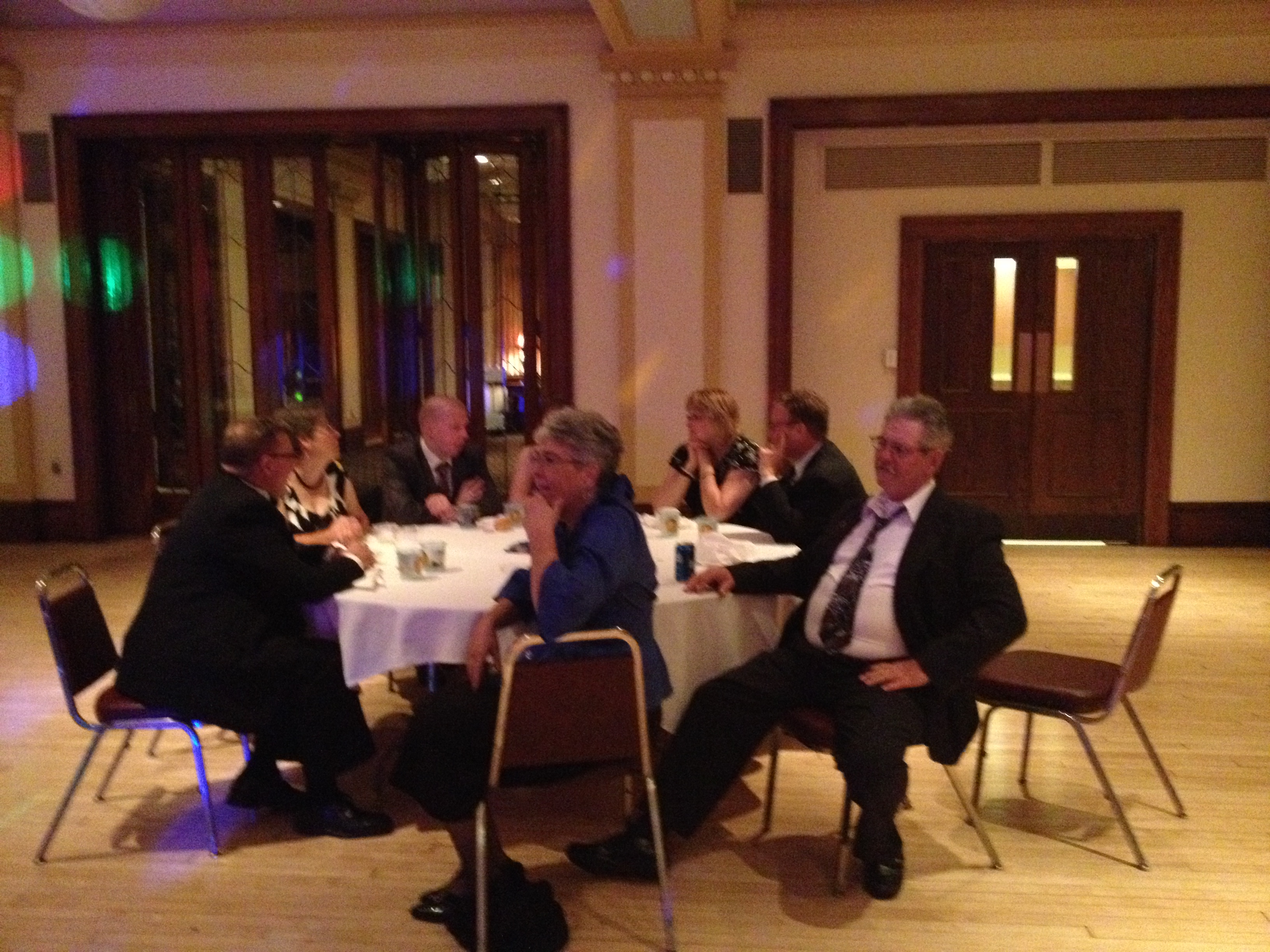
Folks enjoying the food!
We had a nice dinner, catered by a brother, as I said previously. T had decided early on that it was simply better to just not give anyone a choice as far as the protein was concerned, and so, everyone had chicken and salmon. This did lead to some confusion, since it’s not normally done that way, so many people who called to buy their tickets still told us which one they wanted. Oh well.
After dinner, T took the time to thank everyone for coming, thank the families from the lodge who had put work into setting up the ball, and recognizing those who were Past Masters, not only of his Lodge, but also those who had come in from other area Lodges. We were lucky enough to have a few Grand Lodge officers there, including the Deputy Grand Master for our state (aka, the guy who is going to be Grand Master next year).
When that was all said and done, T did something I was not really expecting. He proposed. It was perfect really; I was in a floor length ball gown with his grandmother’s pearls, I had spent the money to get my hair and makeup done, every detail had been meticulously planned; all of our friends and both of our families were there. Not only did I look like a princess, but he made me feel like one too (and you always have!). So, guys, take note. 🙂

Our special visitor, to help us celebrate.
The rest of the evening, the whole evening, was very relaxed. Although all of us were in our formal attire, most everyone there knew each other, and so really it was just a fancy party with all of our friends. The ball continued late into the night, with about as much drinking and dancing as you might expect; a lot and, not quite as much.
If anyone’s Lodge hosts a Master’s Ball or something similar, I would love to hear about it. If yours does not, encourage your Mason or Worshipful Master to bring it up at a business meeting. While it is not profitable, and indeed, we operated ours at a loss, sometimes you just need to put on your fanciest outfit and have a nice dinner with your friends; it’s all about having fun!

Naviagting Masonic Emblems Part II
Since our Master’s Ball is this weekend (more on that next week!), I am in a bit of a time crunch, so, I decided to go ahead with the second part of the Masonic emblem series this week. You can read part one here.
The crescent and scimitar

Probably the second most well-known Masonic emblem, after the square and compass, is that of the Shriners. Luckily for us, the Shriners are much more forthcoming as to the meaning of their emblem than anyone else seems to be. The crescent and scimitar are most often seen displayed on the fez, the hat that a Shriner wears. The scimitar (the sword) stands for the backbone of the fraternity, which are its members. The two claws that make up the crescent represent the Shriners fraternity and its philanthropy. The sphinx’s head stands for the governing body of the Shriners, the head of the organization. The five-pointed star inside of the crescent represents the thousands of children that the Shriners help through their philanthropy (most notably their hospitals) each year. Occasionally you will also see the phrase “Robur et Furor” on the emblem, which means “Strength and Fury”.
The Eastern Star

Perhaps the most misunderstood Masonic emblem is that of the Order of the Eastern Star. Each point of the star represents a different star point. The blue point with the sword and veil represent Adah, whose lesson is obedience to duty. The yellow point with the sheaf of wheat is for Ruth, whose lesson is adherence to religious principles. The white, with the crown and scepter represents Esther, whose lesson is the virtue of loyalty. The green point with the broken column is for Martha, who teaches us the virtue of endurance in a trial. Finally the red point with the cup is for Electa, who teaches ous the lesson of endurance of persecution. The altar with the book in the middle is exactly what you think it is, it represents the volume of sacred law that sits in the East. The word FATAL is the secret phrase used in OES. Please note: OES was created in the 1850’s, long before the inverted pentagram was associated with satanic ritual around the 1960’s.
The crest of the Order of DeMolay

DeMolay, the organization for young men, is also straightforward with their emblem. The crown is symbolic of the Crown of Youth, and reminds a member of his obligations and the seven principles of his order. Each of the ten rubies along the sides of the emblem represent the Founder of the organization, and the nine original members. There used to be a mixture of pearls and rubies, with pearls representing living members, and rubies, deceased ones. The helmet on top represents the concept of chivalry, a reoccurring theme within DeMolay. The crescent in the center serves as a reminder to never reveal the secrets of the Order, nor the secrets of a friend. The five-armed white cross symbolizes the purities of ones intentions, and to always remember the motto, “No DeMolay shall fail as a citizen, as a leader, and as a man.” The crossed swords in the background are symbols of justice, fortitude, and mercy, and also symbolize the warfare DeMolays face against arrogance, despotism, and intolerance. The stars around the crescent serve as a symbol of hope, and remind members of their obligations and duties that one brother owes to another.
The rainbow

Surprisingly, the International Order of Rainbow for Girl’s emblem is the hardest one to find out any information on, much more than any of the Masonic “secrets”. However, from what I can gather, the red, white, and blue stripe represents the flag of the United States; although Rainbow is an international organization, it was created here in the States. The hands below represent friendship. Each of the colors represent a different lesson taught in the organization. Red, love; orange, religion; yellow, nature; green, immortality; blue, fidelity; indigo, patriotism; violent, service. BFCL stands for bible, flag, constitution, and lambskin, the four symbols of the order. The R in the middle simply stands for rainbow.
Job’s Daughter’s emblem

The emblem for Job’s Daughters is very quite simple. The three women in the triangle represent the daughter’s of Job, and each one holds a symbol important to the organization. The dove stands for peace and purity, the urn of incense represents prayer, and the horn of plenty represents the hope of reward for a job well done. The words “Iyob Filiae” literally means Job’s Daughters in Greek.
These are only the emblems for the most common Masonic organizations. There are many others out there, so occasionally you may come across an emblem that is unknown to you. A little research goes a long way in this case.
As always, have a wonderful week!
Navigating Masonic Emblems Part I
Between symbols and symbolism, there’s a lot more than meets the eye when it comes to Freemasonry.While going over every symbol and emblem you may come across would take quite a while, even just those in blue lodge, I did want to take some time to explain those that you may see on a regular basis. Most all of these are associated with appendant bodies (save the first one). Unfortunately, time dictates that I cannot cover every one, so I will go over each of the more common ones. A future post will cover symbols you will only find in blue lodge, as well as, perhaps, the symbols of the less common appendant bodies. While I cannot tell you all of the meanings behind every emblem, this can help you recognize the emblems associated with popular Masonic bodies. Please note: it is proper to say that all of these are emblems, that represent a specific group as a whole. Due to the nature of the English language however, I will be using the words emblem and symbol interchangeably.

The Square and Compass

Perhaps the most well know, most prevalent, and most easily recognized symbol of Freemasonry is the square and compass. This is the symbol of the Blue Lodge. The compass is on top, with the square below. Duncan’s Masonic Monitor from 1866 explains it thusly, “The square, to square our actions; The compass to circumscribe and keep us within bounds with all mankind.” The tools represent judgement and discernment, and more is given on these lessons within the degrees. You may find a square and compass with or without a G. In many English-speaking jurisdictions, especially within the United States, the G is there. It represents the Great Architect of the Universe, which is how Masons refer to G-d, as well as geometry, the science that Freemasonry is founded upon.
Both Scottish Rite and York Rite have different symbols associated with each degree. I will only be covering some of the more common ones, please know that there are many more out there.
Yod
This:

is the symbol for the Lodge of Perfection, which includes the 4th-14th degrees of the Scottish Rite. If you’re not sure what the squiggly line has to do with anything, it may help to know that it is not English. This symbol is the Hebrew letter Yod, which is the first letter of the sacred name of the Supreme Being YHWH- one of the Hebrew names for G-d. Each of the four letters represent different tenses of the verb “to be”. HVH- to be, HYH- was, YHYH- will be. G-d always has been, and always will be, at the heart of Freemasonry.
Double Headed Eagle

This emblem, which belongs to the 32nd degree of the Scottish Rite, also known as Commandery, has long been a hot button topic for the nay sayers of Freeemasonry. In fact, the double-headed eagle has been used as a symbol for many centuries, by many different kings and countries. In Masonry, it serves as an obvious symbol of duality, that unites two opposites into one wholeness, religion and science, for example. It also teaches that one must look to both the past, as well as the future, in order to get a better understanding of the world around us. The 32 refers to its symbol for the 32nd degree (sometimes you will see it with a 33 for, you guessed it, the 33rd degree.) The phrase “Spes mea in Deo est” translates to, “My hope is in G-d.”
Triple Tau

Moving from the Scottish Rite over to the York Rite, the triple tau is the emblem of the first four degrees, commonly referred to as the Capitular Degrees, or Royal Arch Masonry. It is exactly as it appears, three T’s joined at their base. It is said that it has three different meanings, which only seems appropriate. The first, is that the letters T and H (the two bottom tau make up the H), make reference to Hiram of Tyre and Hiram Abif, the designer of the Temple of Solomon. Secondly, it can signify Templum Hierosolym, another name for the Temple of Jerusalem, and may serve as a reminder that the wearer of the emblem acknowledges himself as a servant of G-d. The third significance, is from Christians in Greek or Roman influence, who used it as a symbol of the holy trinity.
The Sword and Trowel

The sword and trowel is the symbol of the Cryptic Masons, which encompasses the next three degrees of the York Rite. The circle, as seen in many of the other emblems, has no ending and no beginning, and can represent infinity or eternity. It may represent freedom, unity, completeness, and harmony. It can also be a reminder of constraints, to constrain our prejudices, our passions, and our interests from betraying us. The triangle, which has three points, can serve as many reminders: the past present and future; the three Magi,the three stages of life; the three Great Pillars, etc. This is the first time that the sword and the trowel are seen together within Masonry. The sword is an emblem of duality, and not only symbolizes security, but also light, purification, righteousness, spiritual transition, and from its double-edged it shows us the defensiveness and destructiveness. The trowel is a reminder of the Master Mason degree, where it is a major focus. The trowel is used to spread the cement of Brotherly Love that unites all of the stones (Brothers) into one common structure (the Fraternity).
The Seal of the Knights Templar

The Knights Templar make up the last few degrees of the York Rite, called orders. The interesting thing about this emblem, is that each part of it is the emblem of each specific degree within the order. The cross and crown represent the degree of the Knight of the Temple, also called the Order of the Temple. As the Order of the Knights Templar is a Christian order, the cross and crown makes sense, as it has been a symbol of Christianity for centuries. The black cross around it, called a Maltese Cross, is the symbol of the Degree of Knight of Malta, also known as the Order of Malta. The Maltese Cross became associated with the Knights when they were on the island of Malta, and appeared on the coins of the country in the 16th century. The crossed swords pointed downward are the symbol of the Degree of the Knight of St. Paul, also known as the Mediterranean Pass. The phrase “In hoc signo vinces” translates to “By this sign though shalt conquer”, which is a reference to the story of Constantine.
Often, only the cross and crown are used to signify the Knights Templar:

The simplifying of this symbol makes it easier to create an overarching symbol for York Rite (which Scottish Rite seems to be lacking):

I hope this has helped understand a bit more of the symbols you may see around your local Lodge, or even on cars on the freeway. I will be going over different auxiliary groups emblems in the future.
As always, let me know if you have any questions, and have a great week!
 The Mason's Lady
